

2023-03-28 00:00:00
CAN WE PREVENT A HERNIATED DISC?
The term "herniated disc" has become quite popular when we are talking about spinal disorders. It is important to ...


The waist-balance ratio refers to the ratio between the size of the waist circumference and that of the hips and as a calculation, the ratio is found by dividing the circumference of the waist by that of the hips.
Several places are indicated for measuring the waist and hips, but the most practical are above the navel, in the case of the waist and in for the hips – in the widest part of the hips or buttocks.
The waist-to-hip ratio is used to assess health, fertility and the risk of developing serious health problems. Research shows that people who have more tissue around the waist (the body is apple-shaped) are more likely to develop various diseases, compared to pear-shaped bodies, that is, with more tissue in the hips
Also, the waist-to-hip ratio is an important indicator of obesity, which in turn can cause serious health problems. It is considered abdominal obesity and implicitly an increase of the risk of developing various diseases caused by excess adipose tissue, when the waist-balance ratio exceeds 1.00 in the case of men and 0.85 in the case of women.
| Waist-to-hip Ratio | Men | Women |
|---|---|---|
| Normal weight | 0,90 | 0,80 |
| Overweight | 0,90-0.99 | 0,80-0,84 |
| Obesity | >1,00 | >0,85 |
If the risk of obesity were assessed on the basis of the waist-to-hip ratio and not on the basis of the body mass index (BMI), the percentage of people at risk of heart attack worldwide (consequence of obesity) would be 3 times higher. In conclusion, the waist-to-hip ratio is an important predictor index of cardiovascular diseases.
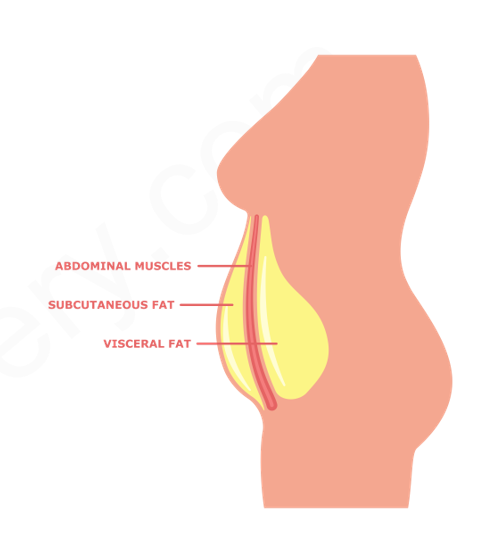
The stress hormone, cortisol, has been associated many times with higher levels of abdominal fat and implicitly with increased waist-to-hip ratio. Abdominal fat is most often associated with visceral fat (fat around important internal organs, such as the liver, pancreas, intestines) and also presents a higher blood flow and more receptors for cortisol than peripheral fat. The higher the number of cortisol receptors, the more sensitive visceral adipose tissue is to cortisol. This heightened sensitivity stimulates fat cells to increase in size.
It has been shown that a waist-to-hip ratio of 0.9 for men and 0.7 for women corresponds to a good state of health and fertility. Women with a waist-to-hip ratio of 0.7 have optimal levels of estrogen and are less at risk of serious conditions such as diabetes, cardiovascular or ovarian diseases and women whose waist-to-hip ratio exceeds 0.8 are less likely to get pregnant. Similarly, men with a waist-to-hip ratio around 0.9 were found to be healthier and more fertile and less at risk of developing prostate or testicular disorders.
Menopause is often associated with an increased waist-to-hip ratio, regardless of whether there is weight gain or not. The estrogen deficiency associated with menopause results in the accumulation of fat deposits around the abdomen. Similarly, older men also accumulate fat around the abdomen and implicitly have an increased waist-balance ratio, as the level of androgen hormones decreases.
In men, the hip waist ratio is not an important element in terms of attractiveness, but rather the waist-chest ratio. In women, however, the waist-to-hip ratio is an important factor in terms of attractiveness.
There is a close connection between the composition of the food and the deposition of adipose tissue around the waist. A diet rich in fruits, vegetables, low-fat dairy, whole grains and low in red meat, processed products, fast food and soft drinks and/or alcoholic beverages, helps prevent the accumulation of adipose tissue around the abdomen.
Abdominal fat can be reduced by adopting a diet and by practicing regular exercise. Men can lose weight much easier than women because they have a much higher percentage of muscles and thus burn much more calories if they practice sports.
Also, keeping portions under control is important, because even in the case of a healthy diet you can consume many calories.
Most healthy adults are encouraged to practice moderate-intensity exercise, such as walking, for at least 40-60 minutes daily or intense exercise, such as running, for at least 20-40 minutes daily. In addition, exercises for toning muscle mass are also recommended, at least twice a week.
Consulting a physical therapist to draw up an exercise program tailored to individual needs is important because various musculoskeletal deficiencies are often associated, such as a poor posture for example.
➢ Normalizing the waist-to-hip ratio requires effort and a lot of patience. Losing excess belly fat and maintaining the results obtained for a long time is a slow and constant process

I always follow professional workflow and provide you the best service with reliable costs.



The term "herniated disc" has become quite popular when we are talking about spinal disorders. It is important to ...
We seldom think about the health of our bones, although the bone skeleton, consisting of 206 bones, not only provides ...
The waist-to-height ratio is a unit of measurement of the distribution of body fat and is calculated by dividing the ...