


2023-03-03 00:00:00
THE OSGOOD-SCHLATTER DISEASE
The Osgood-Schlatter disease is a condition that causes pain and inflammation under the knee joint, where the patellar ...


Nerve roots or spinal nerve roots come out of the spinal marrow through the vertebrae and can be compressed anywhere on their trajectory. For example, disc herniation can compress the nerve roots causing intense pain, gait damage and sensory impairment (stinging sensation, tingling, numbness). Most often, nerve roots are compressed between the vetrebrae.
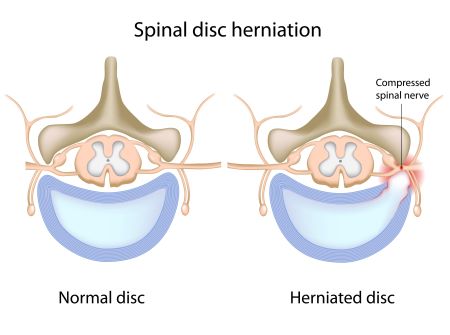
Compression of the nerve root can range from mild to severe, debilitating.
Mild compression most often requires only drug treatment and conservative treatment (physiotherapy, physical therapy, manual therapy), while severe compression may require surgery.
A physician or a manual therapist will diagnose the condition based on the medical history, a spinal examination and a neurological examination. The confirmation of the diagnosis is made by an MRI examination (nuclear magnetic resonance) examination.
The spine consists of a number of 33 -34 small bones, called vertebrae. Superiorly, the first 24 vertebrae (from the cervical, thoracic and lumbar level) are articulated and separated from each other by the intervertebral discs. Inferiorly, at the level of sacral areas there are 5 welded vertebrae and at the level of the coccyx, bone located at the base of the spine, there are 4-5 joined vertebrae. The vertebrae are connected to each other, thus creating the vertebral canal in which the spinal marrow is housed and protected.
Ligaments, nerves, muscles and intervertebral discs are additional components of the spine.
Intervertebral discs are structures of fibrocartilaginous nature, placed between two vertebrae. They are essential for the movement of the spine and act as a ligament, tying one vertebra to the next, but especially they have a role in the absorption of shocks, significantly diminishing the impact between the vertebrae.
When the discs slide back, they can compress the roots of the spinal nerves, causing pain or sensory disturbances. The best-known example is sciatica, which manifests itself with pain and inflammation along the sciatic nerve, due to compression of the root of the sciatic nerve.
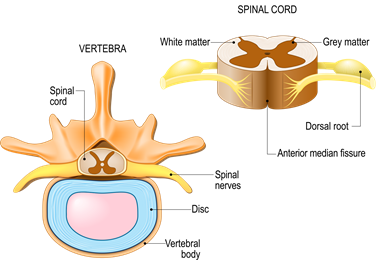
It is the main cause of compression of the nerve roots. The disc tends to slide back and sideways, touching the nerve root.
When the discs degenerate, with age or as a result of overstrain and wear of the spine, they narrow and swell, which can compress the nerve root.
It is a condition of the spine that occurs when one of the vertebrae slips out of its place, on the vertebra beneath it, which leads to the instability of the spine and can also put pressure on the nerve root.
A condition caused by wear or degenerative changes in the spine, which leads to osteophytes and thickening of the joints, which in turn can compress the nerve roots.
The goal of any method of treatment for spinal nerve compression is to alleviate the underlying cause of compression.
Nonsteroidal anti-inflammatory drugs are often used to relieve pain and improve the quality of life, while facilitating healing. Injectable treatment is used when compression of the nerve roots is not significantly remedied after a while. Two different techniques are often used: nerve root canal injections or epidural injections, especially in the cervical and lumbar spine. Both techniques aim at the same goal, namely the alleviation of pain and inflammation at the affected nerve root.
They have an important role in increasing the flexibility of the muscles and restoring the functionality of the back, thus allowing the development of daily activities.
Physical exercises to tone the basic muscles of the body, such as the paravertebral, abdominal and buttock muscles, are absolutely necessary to support the spine.
Exercise is also important for improving posture, which is often a cause of back pain.
Locally applied ice helps reduce inflammation. Always put a thin towel between the ice and the area on which it is applied.
Topically applied heat helps to relax muscles and improve blood flow. The two variants of thermotherapy, ice and heat, will be applied alternately.
Micro-discectomy is frequently performed to decompress the nerve by removing the part of the intervertebral disc that affects the nerve root.
➢ Attention will be paid to posture and positions that relieve pain should be adopted
➢ Rest does not accelerate the recovery process, controlled physical activity is necessary
➢ Normal daily activities do not hinder the recovery process.

I always follow professional workflow and provide you the best service with reliable costs.



The Osgood-Schlatter disease is a condition that causes pain and inflammation under the knee joint, where the patellar ...
The skeleton of the forearm consists of two long bones, radius and ulna, which form the radioulnar joint and which are ...
One of the most important elements of exercising, recreational or performance, is recovery and it is also one ...