


2023-04-10 00:00:00
FRACTURES OF THE FINGERS
Fractures of the hand can occur either at the level of the small bones of the fingers (phalanges) ...


The radial tunnel syndrome can cause pain and muscle weakness in the hands and fingers. In most cases, radial tunnel syndrome can be easily managed using conservative treatments. Only in severe cases, surgery may be required to reduce pressure on the affected nerve (radial nerve).
The radial tunnel syndrome occurs when the radial nerve is compressed or brushed when passing through an osteo-tendinous tunnel (radial tunnel) located at the level of the elbow. The nerve passes through the radial tunnel under the supinator muscle. If there is a thickening around the supinator muscle, the nerve could be compressed. Compression occurs at a 5 cm distance from the elbow in most situations, hence the confusion with the condition called "the tennis player’s elbow".
Radial tunnel syndrome usually does not cause numbness or tingling in the fingers.
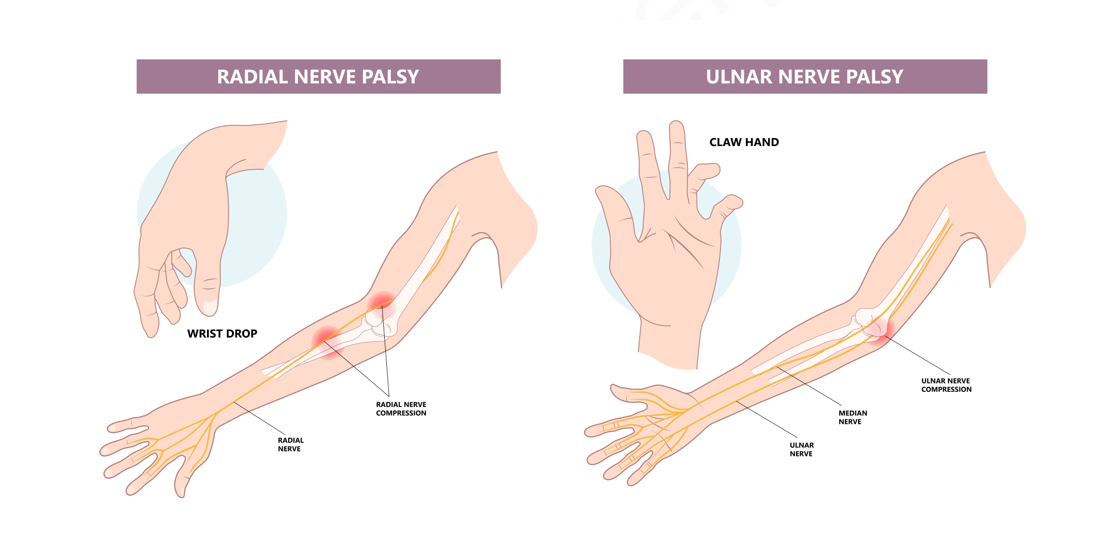
The radial nerve and its branches ensure the motor innervation of the muscles located on the dorsal side of the arm, as well as the motor innervation of the extensor muscles of the joints and hands.
Also, the radial nerve provides cutaneous sensory innervation to most of the palmar side of the hand, except for the little finger and the adjacent half of the ring finger (which are innervated by the ulnar nerve).
The radial nerve divides into a deep branch, which becomes the posterior interosseous nerve and a superficial branch, which continues to innervate the palmar side of the hand.
The posterior interosseous nerve is the one that is subjected to pressure or compression, most often due to repetitive movements of the hand and wrist or due to pressure at the elbow level.
The radial tunnel is located between the upper arm bone (humerus) and the head of the radius bone (the radius is one of the two bones of the forearm, next to the cubitus). The radius bone connects the thumb with the elbow and the part that connects to the elbow is known as the radial head.
Daily professional and recreational activities will be analyzed to see if one of them causes compression of the radial nerve.
Checking the position at the desk but also the desk configuration can be very useful to avoid compression of the radial nerve at the elbow level, when the elbow is supported on the desk for a long time. Basically, prolonged pressure on the elbows during daily activities will be avoided.
Ice applied topically on the affected area for 5-10 minutes, 3-5 times/day, helps reduce pain but also inflammation. Always put a thin towel between the ice and the area on which it is applied.
Local injections of corticosteroids (stronger anti-inflammatories) can help relieve pressure and inflammation on the radial nerve.
Specific exercise programs are the basis for recovery in mild cases of radial tunnel syndrome.
Wearing a splint for the elbow during sleep can prevent bending of the elbow and compression of the radial nerve.
Wearing a protective pad on the elbow during daily activities protects the elbow and implicitly the radial nerve.
In severe cases, the surgery to decompress the radial nerve alleviates the pressure on it.
Surgery includes either moving the nerve to the front of the elbow or moving the nerve under the fat layer, under the muscles or in the muscles.

I always follow professional workflow and provide you the best service with reliable costs.



Fractures of the hand can occur either at the level of the small bones of the fingers (phalanges) ...
Plantar fasciitis, which represents inflammation of the plantar fascia, is one of the most common causes that ...
Osteochondrosis is a condition caused by wear of the intervertebral disc and adjacent vertebrae, due to severe ...