


2023-03-27 00:00:00
URINARY INCONTINENCE
Urinary incontinence - loss of bladder control - is a common and often embarrassing problem. It ranges from the ...


De Quervain tenosynovitis or tendonitis is a painful inflammation of the tendons of the thumb, named after the Swiss surgeon who discovered this condition. Tendons are bands of tissue that attach muscles to the bones.
Usually, the tendons slide easily through a tunnel of tissue called sheath. Inflammation (swelling) of the tendons or thickening of the sheaths causes pain because the tendons can no longer easily slide through their sheaths and certain movements of the thumb and wrist become difficult to execute.
De Quervain tenosynovitis is one of the most common types of tendon inflammation, as women are affected 8 to 10 times more frequently than men.
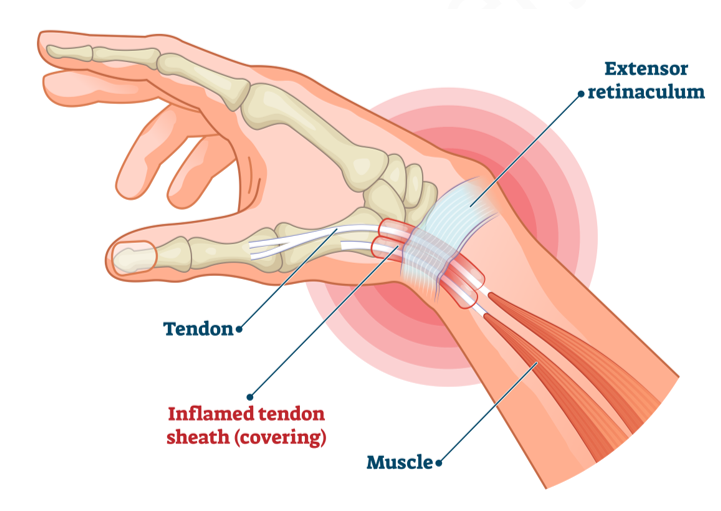
• Repetitive moves that require lateral movement of the wrist and thumb grip, from sports or activities (tennis, skiing, gardening, using the hammer, lifting the child). It is popularly called mothers' disease, precisely because it occurs from the repetitive movement of lifting children.
• Direct blows to the thumb
• Inflammatory disorders (arthritis)
Tenosynovitis manifests with pain and tenderness at the level of the lateral part of the hand and thumb, pain that is accentuated when using the thumb for activities such as catching objects or grabbing them.
For the diagnosis of De Quevain tenosynovitis, the following test is performed: with the fingers tight in the fist, the thumb being on the inside, the wrist moves up and down. Thus, the swollen tendons are forced to pass through the narrow sheath. If this movement causes pain, then it is possible that the De Quervain tenosynovitis may have installed.
1. A splint or orthosis worn non-stop, for a period of 4-6 weeks, helps relax the hand and thumb, avoiding being moved.
2. Ice applied topically, in sessions of 5-10 minutes, 3-5 times a day, helps reduce inflammation. The ice will always be wrapped in a thin towel so as not to irritate the skin.
3. Avoid activities that accentuate pain.
4. Anti-inflammatory drugs or local injections into the tendon sheath, with corticosteroids that are stronger anti-inflammatories, help reduce pain and inflammation.
5. Surgery is indicated if the procedures listed above do not help relieve pain and inflammation or resume the range of movements of the thumb and wrist.
6. Physical therapy, through specific exercise programs, helps to tone the muscles around the thumb and wrist and is indicated both after surgery and the treatment of tenosynovitis that do not require surgery.
The recovery time through physical therapy varies depending on how tenosynovitis was installed, if the symptoms set in quickly, the recovery is shorter, if the symptoms were installed progressively, the recovery may take longer.
The exercises are aimed at:
• reducing pain
• prevention of stiffness in the thumb and wrist
• regaining the total joint amplitude (complete movement)
• strengthening the muscles in the hand and fingers, thus preventing relapses or other injuries.

I always follow professional workflow and provide you the best service with reliable costs.



Urinary incontinence - loss of bladder control - is a common and often embarrassing problem. It ranges from the ...
Bursita popliteala care reprezinta inflamarea bursei popliteale, este cauzata de un exces de lichid provenind ...
The humerus is one of the three bones that form the elbow joint, along with the radius and ulna. Together, they bend and ...