


2023-03-13 00:00:00
BALANCE
Balance is a term frequently used by healthcare professionals, as there is no universally accepted definition of human ...


Warming-up before exercising is vital for achieving the desired performance. Warming-up techniques can be classified into two major categories: passive warming-up and active warming-up. Passive warming-up, carried out with the help of external means, such as: a hot shower, wearing heated clothing items, sauna, or the use of creams with a warming effect, increases the body temperature without depleting its energy deposits. Less used today, passive warming-up techniques maintain high muscle temperature throughout the transition phase (the period between completing the warming-up and starting training).
More frequently used, the active warming-up, achieved through physical exercises performed at a very low intensity level, which mainly targets the muscles involved in the training that follows, induces greater metabolic changes, which leads to increased preparation for further exercises.
It has also been assumed that warming-up, passive, or active, can have a number of psychological effects (for example, increasing the degree of preparation)
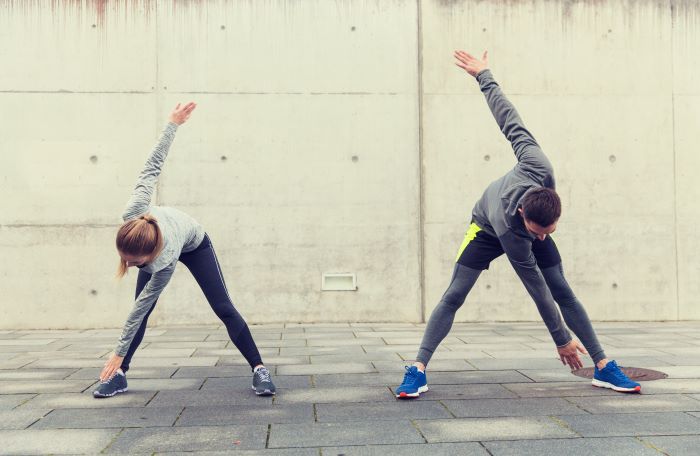
Most active warming-up sessions include a combination of cardiovascular exercises (easy running outside or on the treadmill for 10 minutes), stretching exercises and light exercises (rotating the head, shoulders, arms and pelvis, alternately lifting the knees to the chest, lifting on the tops of the legs, bending the torso towards each leg etc. and explosive force exercises (sprints, bounce, jumps).
Cardiovascular exercises increase blood circulation, body temperature and heart rate.
Stretching exercises should be done after the warming-up phase when the muscles are already warm, improving both muscle flexibility and the range of movement of the joints, preventing, at the same time, the appearance of muscle pain or injuries.
Light warming-up exercises prepare joints and muscles for the effort that follows, and explosive force exercises slightly increase the intensity level of warming-up and prepare the body for sudden movements in training or sports play. These exercises should be done only after the muscles are already warmed up to prevent injury.
Warming up prepares the body for the physical exercises that follow by gradually increasing the heart rate (the number of beats per minute) and blood circulation. This will increase blood flow to the muscles.
Warming-up is also a good opportunity for a person to mentally prepare for the training or game that follows. In the case of team games, warming-up can also be useful in practicing team skills and exercises.
Most warm-up sessions last an average of 20-30 minutes, the body needs this time to be ready for the physical activity that follows but also for the mental preparation.
Mild sweating is a good indication of an effective heating
First of all, to prevent lesions or injuries during exercise.
Maintaining warm muscles will prevent both acute injuries (muscle stretches) and injuries caused by overstrain (muscle or ligament/tendon ruptures).
In team sports, football for example, replacements should continue to run and stretch while waiting to join the game.
In addition, practicing physical exercise without warming up places a potentially dangerous stress on the heart, warming up reducing this stress.

I always follow professional workflow and provide you the best service with reliable costs.



Balance is a term frequently used by healthcare professionals, as there is no universally accepted definition of human ...
The runner's knee is one of the most common types of overwork injuries commonly found in runners. It occurs when ...
The use of the foam roller is a simple technique of manual self-therapy, often used to improve flexibility, to reduce ...