


2023-03-07 00:00:00
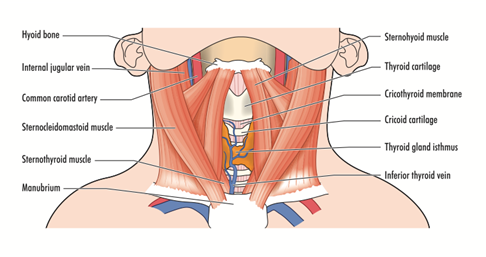
THE 5 MOST USEFUL EXERCISES FOR NECK PAIN
Neck pain (not throat pain) and stiffness can have many causes, but most commonly it is caused by tense and tired ...


The slippage of the femoral epiphysis is a disorder that affects the adolescent's hip. Fortunately it is quite rare and is often attributed to a weakness of the growth plaque.
In most cases, the slippage of the femoral epiphysis is a slow and lasting process. In rare situations, this process, the slippage of the femoral epiphysis, can occur suddenly (as a result of a trauma or a fall).
Most often, it develops during periods of rapid growth, generally after the beginning of puberty. Boys are two to three times more likely to develop the condition
Many persons who suffer from this condition are overweight, a situation in which losing excess weight and returning to a normal weight, according to age and height, are extremely important.
Gait observation, physical examination and hip radiographies are necessary in establishing the diagnosis. Early diagnosis of the disease and early treatment have an important role in the stabilization of the hip.
The hip joint is the largest joint in the body and consists of:
➢ The spherical end of the femoral bone, which is practically about 2/3 of the joint
➢ The acetabular or glenoid cavity, in which the femoral end is fixed
Basically, the hip joint connects the femur (thigh bone) to the pelvis, allowing the foot to move.
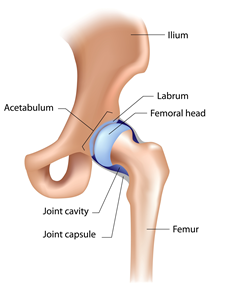
The femur, the largest bone in the body (in adults it measures 40-50 cm), has at its upper extremity, also called the upper femoral epiphysis, the femoral end that is connected to the body of the femur (or diaphysis) through the femoral gap. At the union of the femoral gap with the femoral diaphysis there are two protrudings called the big trochanter and the small trochanter.
The big trochanter presents itself as a protrusion or tuberosity pointing upwards, which continues the body of the femoral bone upwards. The big trochanter can easily be felt on the side of the thigh. On the big trochanter are inserted some muscles that connect the pelvis with the femur, namely the middle buttock, the small buttock, the pyriform, the internal shutter.
The small trochanter is the point at which the iliopsoas muscle is attached to the hip joint, ensuring the flexion movement of the hip (bringing the knee to the chest).
The main goal of the treatment is to prevent additional slippage of the femoral end until the growth plaque is closed. If the femoral end gets to slide more from its position, as a secondary reaction, early osteoarthritis may develop.
In this case, treatment should be instituted immediately.
Fixing the head using needles or screws is a commonly used treatment method. Depending on the severity of the condition, three different types of surgery are indicated:
1. placement of a screw in the femoral epiphysis and in the thigh.
2. reduction of the displacement and mounting one or two screws in the femoral end.
3. removal of any abnormal growth plaque and insertion of screws to help prevent further displacement of the femoral epiphysis
When the condition is treated early, the long-term result for the hip is good.

I always follow professional workflow and provide you the best service with reliable costs.



Neck pain (not throat pain) and stiffness can have many causes, but most commonly it is caused by tense and tired ...
Suspension training refers to a strength training approach that uses a rope and strap system (TRX) to allow ...
Athletic pubalgia, known as Gilmore's groin, after the surgeon who identified it, is a condition in which the tendons ...