

2023-03-27 00:00:00
URINARY INCONTINENCE
Urinary incontinence - loss of bladder control - is a common and often embarrassing problem. It ranges from the ...


The anatomy of the hand is complex, its integrity being absolutely essential for daily functioning. The hand consists of 27 bones, more precisely the eight carpal bones, the five metacarpal bones and the 14 phalanges (two at the thumb and three – proximal, medial and distal – at the each of the other fingers). In addition to these bones, the hand consists of a rich network of muscles and ligaments and is connected to the forearm by the wrist (carpal bones). This unique arrangement gives the hand great freedom of movement, great flexibility and precision. Hand damage decreases the quality of life due to the fact that all activities related to the daily routine will be harder to perform. Among the main diseases of the hand, we mention:
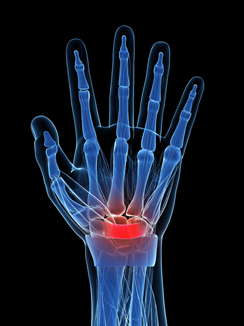
It affects millions of people around the world, setting in with time as the joints degenerate. Another cause of arthrosis is inflammation of the joints, which manifests with pain, stiffness and swelling. Arthrosis of the hand can be quite debilitating because it prevents the performance of many activities related to the daily routine. If healthy joints move quite easily due to the presence of joint cartilage that covers the bone surfaces, in arthrosis, the cartilage is progressively destroyed, and the bone surfaces will rub against each other causing pain, inflammation and joint stiffness. Repetitive movements from certain sports activities or from certain professional activities, such as the repetitive use of the computer keyboard can affect the hand and cause injuries to it. Rest, anti-inflammatory drugs, the use of splints and special exercises for hands, help relieve symptoms, but, since it’s a degenerative condition, the treatment is long-lasting.
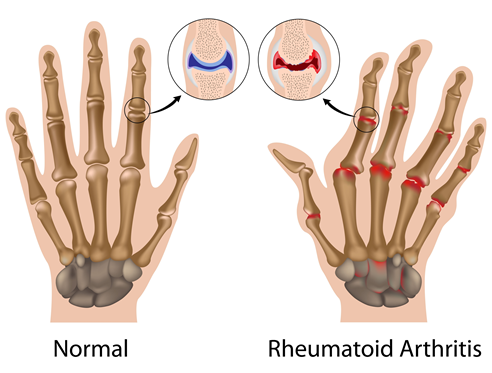
In Rheumatoid polyarthritis, the body's immune system fights against the synovial membrane, which thus becomes inflamed and is associated with a decrease in the amplitude of movement in the affected joint. As the inflammation sets in, the joint capsule becomes swollen and painful and secondarily, the joint becomes unstable with increased pain. The joint cartilage is also affected and may develop some deformities. Although it can affect any joint in the body, Rheumatoid Arthritis tends to start with stiffness and discomfort in a certain area, such as in the hands or feet. Stiffness in the joint is accompanied by redness and inflammation. But there are specific treatments that help manage the condition.
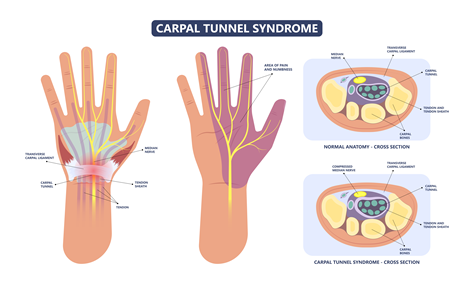
Carpal tunnel syndrome occurs when the tissues surrounding the tendons in the wrist become inflamed and compress the median nerve. These tissues are called synovial and have the role of lubricating the tendons, thus facilitating the movement of the fingers. The inflammation of the synovial narrows the already small space of the carpal tunnel, with time affecting the median nerve. When the median nerve is compressed, symptoms may include numbness, tingling, pain and a feeling of weakness in the hand. Also, repetitive movements in the wrist or anatomical changes in the wrist can cause carpal tunnel syndrome. It is more common after the age of 30, women having a higher risk of developing this condition. Drug treatment, physical therapy and changing the way hands are used can help to properly manage carpal tunnel syndrome.
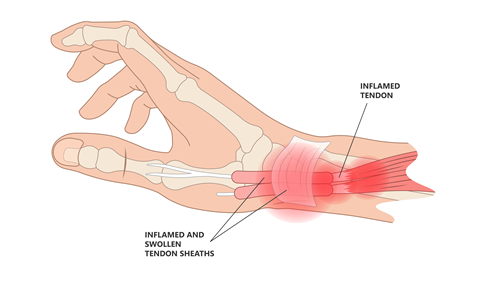
Tenosynovitis or De Quervain's tendonitis is a painful inflammation of the tendons of the thumb, named after the name of the Swiss surgeon who discovered this condition. Tendons are bands of tissue that attach muscles to the bones. Usually the tendons slide easily through a tunnel of tissue called sheath. The inflammation (swelling) of the tendons or the thickening of the sheaths cause pain because the tendons can no longer easily slide through their sheaths and certain movements of the thumb and wrist become difficult to execute. De Quervain’s tenosynovitis is one of the most common types of tendon inflammation, with women being affected 8 to 10 times more frequently than men. The condition can be kept under control with the help of drug treatment, medical gymnastics and, in severe cases, surgery.
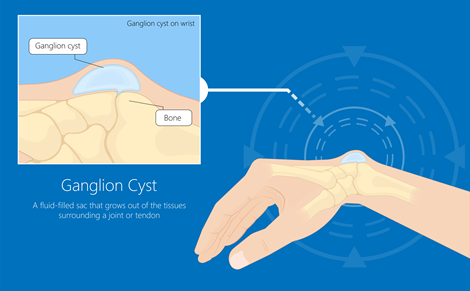
A ganglion cyst is a fluid-filled swelling that usually develops near a joint or tendon. The cyst can vary from the size of a pea to the size of a golf ball. Treatment includes anti-inflammatory drugs to reduce pain and inflammation, wearing splints and, in more severe cases, draining it with a needle or surgery.
A fall on the hand or a weight applied directly to the hand can result in the fracture of one or more bones of the hand. Fracture treatment involves, initially, immobilization of the hand in plaster or plaster splint for a certain period of time, followed by performing a medical gymnastics program, in order to prevent post-immobilization rigidity and to increase flexibility and mobility of the hand. In more severe cases, surgery may be required.
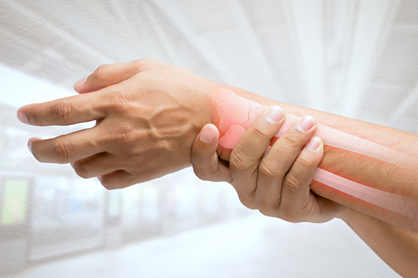
The sprain is a traumatic injury that occurs after stretching over the limit of tolerance or tearing ligaments in the hand joint, caused by a sudden twisting movement or a violent blow. During the blow or overstraining, the ligament of the wrist can suffer from small sprawls to total rupture and can also affect the cartilage, muscle or tendon in that region. As treatment, rest, locally applied ice, compression bandage and elevation (lifting) of the hand help to diminish pain and swelling. The medical gymnastics program, including specific exercises, is important for increasing joint flexibility and mobility.
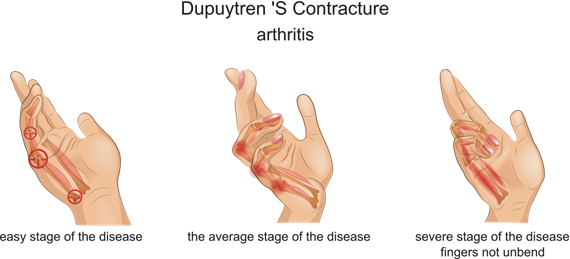
Dupuytren's contracture occurs when the layer of fibrous tissue in the palm and fingers thickens. Even if it is painless, Dupuytren's contracture can cause changes in the fingers, more precisely their contracture and bending. Dupuytren's contracture evolves slowly, begins at the level of the little finger and evolves towards the index finger and then towards the palm. It is not considered a serious condition, but certain functions of the hand can be lost and also the aesthetics of the hand is affected. Local injections with corticosteroids (strong anti-inflammatory) help reduce pain and wearing a splint or orthosis in the early stages of the condition helps keep fingers straight. Surgery can be performed in the more advanced stages, followed by a program of specific exercises, performed daily, useful for the full functioning of the hand.
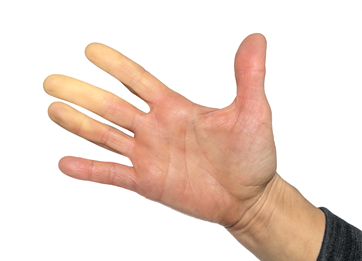
Raynaud's syndrome is a disease that affects the fingers of the hands and feet by the appearance of numbness and cold, when temperatures are low or due to stress. For most people, Raynaud's syndrome is not a serious health problem, however, in some cases, it can have a significant impact on lifestyle. It is recommended to adopt a healthy and active lifestyle, avoid stress factors and smoking, but also sudden changes in temperature.

I always follow professional workflow and provide you the best service with reliable costs.



Urinary incontinence - loss of bladder control - is a common and often embarrassing problem. It ranges from the ...
Lumbar radiculopathy is a condition in which the pain, localized in the lower back, caused by a compressed nerve ...
Neck pain (not throat pain) and stiffness can have many causes, but most commonly it is caused by tense and tired ...