


2023-03-29 00:00:00
DE QUERVAIN TENOSYNOVITIS
De Quervain tenosynovitis or tendonitis is a painful inflammation of the tendons of the thumb, named ...


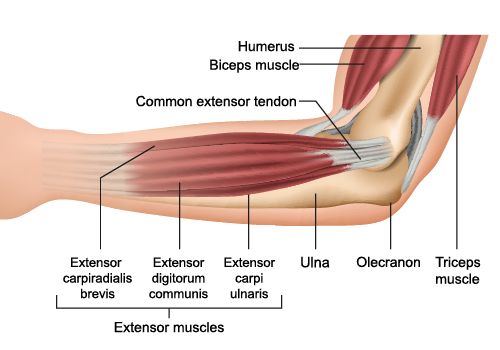
When we bend the elbow, it is quite easy to feel/touch the olecranon. It’s a bone protrusion located at the tip of the elbow, immediately under the skin, without additional protection from other soft tissues or muscles.

Three bones with distinct shapes join together to form the elbow joint, the humerus (arm bone) and radius with ulna (forearm bones). Ligaments that are connected to the bones, work to keep the elbow joint in a proper alignment. As the muscles contract and relax, two distinct movements occur at the elbow level, namely: flexion-extension(bending-straightening) of the forearm and pronation-supination of the hand (turning the palm up and down).
Fractures of the elbow are very painful and occur almost always by falling on the tip of the elbow, on the olecranon. In complete fractures, the olecranon can break into several pieces and in this situation surgical intervention is mandatory.
Some fractures require only the splint to keep the elbow joint in proper position during the healing process. The healing process will be constantly monitored, requiring regular X-rays. If the bone fragments are fixed in place, after a few weeks the elbow can move slightly. It’s forbidden to lift weights with the arm injured, for several weeks.
After the removal of the splint, it is recommended to start a physical therapy program with the following objectives:
✓ increasing articular mobility
✓ regaining the complete amplitude of movement in the joint
✓ toning the stabilizing muscles of the elbow to prevent relapses
✓ reducing pain
It involves the fixation of broken bone fragments.
After surgery, it is also necessary to perform an exercise program for the complete recovery of all movements at the elbow level. Exercises performed at the right time are vital to prevent loss of range of movement.
After the fracture, the mobility interval is determined by 2 factors, namely
1. Changes in the structure of the joint that cause disruption of the bone joint and implicitly the disturbance of movements
2. Stiffness after immobilization or scars, which can lead to elbow stiffness.
The lack of exercises after surgery or after immobilization in the splint is associated with a very rigid elbow and can extend the duration of complete recovery of the elbow up to 12-18 months.

I always follow professional workflow and provide you the best service with reliable costs.



De Quervain tenosynovitis or tendonitis is a painful inflammation of the tendons of the thumb, named ...
Suspension training refers to a strength training approach that uses a rope and strap system (TRX) to allow ...
The femur, the thigh bone, is the longest bone in the body, in an adult measuring 40-50 cm. Fortunately, femoral fractures ...