


2023-03-29 00:00:00
SPINAL STENOSIS
Spinal stenosis is a narrowing of the spinal canal (the canal that houses the spinal marrow) that can put pressure ...


About 80% of people suffer at some point from back pain in the lumbar level. The pain can range from severe to mild and can be long or short-lived. Once installed, low back pain makes it difficult to carry out daily activities and requires a visit to the doctor or physical therapist. One of the most common causes of low back pain is herniated disc, also known as slipped disc or prolapse of disc.

The spine consists of 33 -34 small bones, called vertebrae. Superiorly, the first 24 vertebrae at the cervical, thoracic, and lumbar level are articulated and separated from each other by the intervertebral discs and inferiorly, at the level of the sacral areas there are 5 welded vertebrae and at the level of the coccyx, the bone located at the base of the spine, there are 4-5 joined vertebrae. The vertebrae are connected to each other, thus creating the vertebral canal in which the spinal marrow is housed and protected. The spine has 4 physiological curvatures: cervical, thoracic, lumbar, and sacral. These curvatures increase the strength and elasticity of the spine, maintaining the normal position of the body.
The lumbar spine, consisting of 5 vertebrae, provides support for approximately the entire body weight.
Ligaments, nerves, muscles, and intervertebral discs are additional components of the spine.
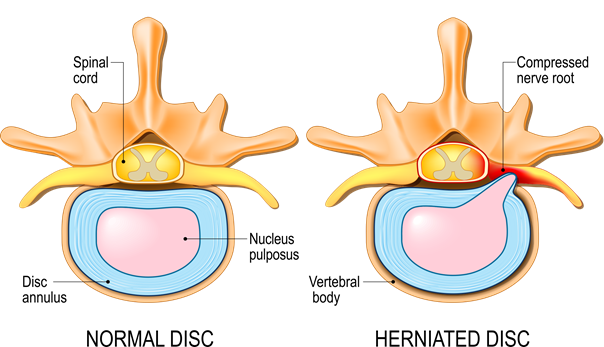
They are structures of fibrocartilaginous nature, placed between two vertebrae. They are essential for the movement of the spine and act as a ligament, tying a vertebra to the next, but especially have a role in the absorption of shocks significantly diminishing the impact between the vertebrae. The discs are round and flat, with a thickness between 9-11 mm and consist of two components, a fibrous ring, and a pulpy nucleus.
The lumbar intervertebral discs are the most demanded, since the greatest pressure acts on them and this is the reason why the most common pathology that occurs in the lumbar spine is disc herniation.
The disc can also swell and press on a nerve root causing numbness and pain on the innervation route of that nerve. The best example is the sciatic nerve that originates in the lumbar vertebra 4 and crosses the entire lower limb, from its upper part to the plantar side of the foot.
Herniated disc is more common in people between the ages of 35 and 65 due to disc degeneration, with aging.
It has an essential role in pain management and in treating a herniated disc.
Initially, programs of exercises and positions will be performed, aiming to:
➢ reduce pain
➢ improve mobility
➢ reduce pressure on the nerve roots
As the exercises are practiced, the pain will attenuate and the recovery program can advance, aiming:
➢ to increase stability, more precisely the ability to control the position and movement in the lumbar area (which includes the abdomen - lower back - pelvic muscles)
➢ to tone the back muscles, important both for its strengthening and for the prevention of relapses or other injuries.
If the pain is mild or moderate, anti-inflammatory drugs help relieve the pain, but are recommended for short periods of time.
If the pain is intense, injections of corticosteroids administered locally, in the epidural space (between the vertebrae and the spinal marrow) at the level of the pain area, are useful for reducing pain and reducing inflammation around the nerve roots.
If the pain is also associated with muscle contracture, myorelaxant drugs help in this situation, but they are also recommended for short periods of time.
If certain movements in the daily routine cause pain, it is recommended to avoid them. The most common movements that cause low back pain are repetitive movements that involve bending the body forward. It is also recommended to shorten the periods of sitting on the chair and alternate them with regular breaks.
It is necessary in the case of a small number of people because the herniated disc responds very well to the treatment measures listed above.
The surgical approach is indicated in severe cases, where the symptoms persist for more than 6 weeks, and the walking is carried out with difficulty or when a ruptured fragment of the intervertebral disc is pushed into the vertebral canal where the spinal marrow is located. Through surgery, most of the time only the affected disc fragment is removed and only in a few situations, the disc is totally removed and replaced with an implant.
➢ It is recommended to lose excess body weight, thus improving the condition of the lumbar area.
➢ Avoid activities that affect the lumbar area, such as those that involve leaning or bending the body forward
➢ Avoid lifting heavy weights
➢ Keep an adequate straight posture as much as possible alleviate the pressure on the intervertebral discs.

I always follow professional workflow and provide you the best service with reliable costs.



Spinal stenosis is a narrowing of the spinal canal (the canal that houses the spinal marrow) that can put pressure ...
Diabetes mellitus is a chronic condition that affects the way the body uses blood sugar (glucose). Glucose is essential for ...
Suspension training refers to a strength training approach that uses a rope and strap system (TRX) to allow ...