


2023-03-13 00:00:00
BACK PAIN BETWEEN MYTH AND REALITY
The back is composed of a complex structure of muscles, ligaments, tendons, joints and bones, which work together to ...


Luxation means an abnormal separation between the bones of a joint.
Ankle luxation is a severe condition and is most often associated with fractures of the malleolus or the posterior side of the tibia.
It can occur in people of all ages.
The ankle is a complex joint, consisting of 3 bones: tibia, fibula and talus (or astragalus) that allow the movement of the foot in all body planes, with the role of absorbing shocks and transmitting the weight to the plantar support in static position but also during movement.
The stability of the ankle is given by ligaments, bone structure and supporting muscles. The ligaments that support the ankle are the deltoid ligament, located on the medial (inner) side of the ankle and the anterior talofibular, posterior talofibular and calcaneofibular ligaments, located on the (outer) side of the ankle.
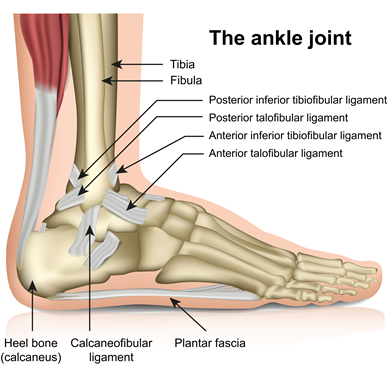
Luxation occurs when one or more ligaments of the ankle are ruptured. Without these ligaments that hold the bones in place, the tibia and talus (the main bones involved in the dislocation of the ankle) separate. This can happen in car accidents or while practicing a sport, especially those that include jumping, more likely to happen if the foot is pointing down during the impact.
Posterior dislocation, the most common type of dislocation, when the talus moves posteriorly to the tibia and is most often associated with fractures.
The anterior dislocation occurs by forcing the anterior leg into the ankle joint, when the foot is fixed and a posterior force is applied to the tibia or by forced dorsiflexion.
Lateral dislocation occurs by forced inversion (internal rotation of the foot) or by forced eversion (external rotation of the apiary). They are lesions uniformly associated with fractures of both malleolus or the distal fibula.
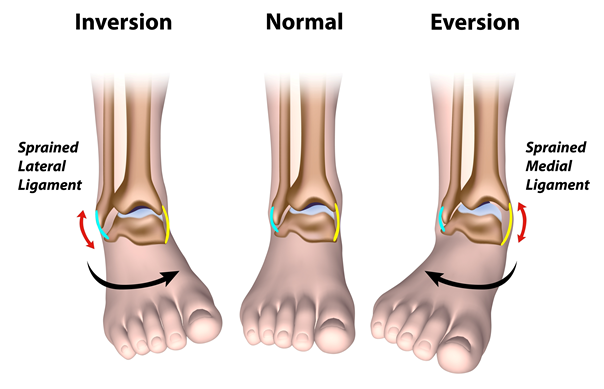
Luxation of the ankle manifests with intense pain, tumefaction (swelling) and bruising, incapacity to put weight on the leg and move the foot.
A physical examination accompanied by an X-ray are needed to identify if there are other lesions or if the blood vessels are affected.
The therapeutic approach depends on the type of dislocation and the associated lesions.
1. Drug treatment
Pain and anti-inflammatory drugs help control pain and inflammation, but are recommended for short periods of time, 7-10 days.
2. Closed reduction of the luxation (putting the bones back), without surgery, followed by immobilization of the ankle with the help of a splint, to keep the bones in the correct position.
3. Elevation (raising) of the ankle on a support or pillow, preferably above the level of the heart.
4. Ice applied topically, in sessions of 5-10 minutes, 3-4 times a day, helps reduce inflammation. Always wrap the ice in a thin towel so as not to irritate the skin.
5. The use of an ankle pad or an elastic, compressive bandage helps reduce inflammation and heal the injured ligaments.
6. Once the tumefaction (swelling) is reduced, it is recommended to use a special boot and the walking will be done with the help of crutches, to avoid straining the foot.
7. Light massage helps to favor circulation.
8. Surgery
It’s necessary in case of severe dislocations, accompanied by damage to the tendons, nerves, and/or blood vessels. After the period of immobilization after surgery, the gypsum will be replaced with a detachable splint, which allows the start of the recovery program.
9. Physical therapy
It is indicated both in the case of dislocations without surgery, as well as in the case of surgery after the period of immobilization, aiming at:
➢ regaining mobility in the joint
➢ regaining the stability of the joint
➢ toning the supporting muscles of the ankle
➢ reducing pain
➢ prevention of relapses
Full recovery after an ankle luxation can take from 4 weeks to several months.
➢ In the case of athletes, warm-up before training and recovery after training have an important role in preventing luxation
➢ Adequate footwear has an important role, generally, not only in the case of athletes, sports shoes or ones with low sole being recommended
➢ An ankle pad can be worn after healing, especially in the case of athletes who need greater freedom of movement, thus supporting the overworked ligaments.
➢ Regular exercise helps to tone the supporting muscles of the ankle and implicitly to prevent ankle disorders

I always follow professional workflow and provide you the best service with reliable costs.



The back is composed of a complex structure of muscles, ligaments, tendons, joints and bones, which work together to ...
A hip prosthesis is a medical device that replaces a damaged hip joint.The hip joint is the largest joint in the body ...
Balance is a term frequently used by healthcare professionals, as there is no universally accepted definition of human ...