

2023-03-13 00:00:00
PAIN IN THE LOWER BACK
Low back pain or lower back pain can range from mild to severe; it can be long-lasting or short-lived affecting daily ...


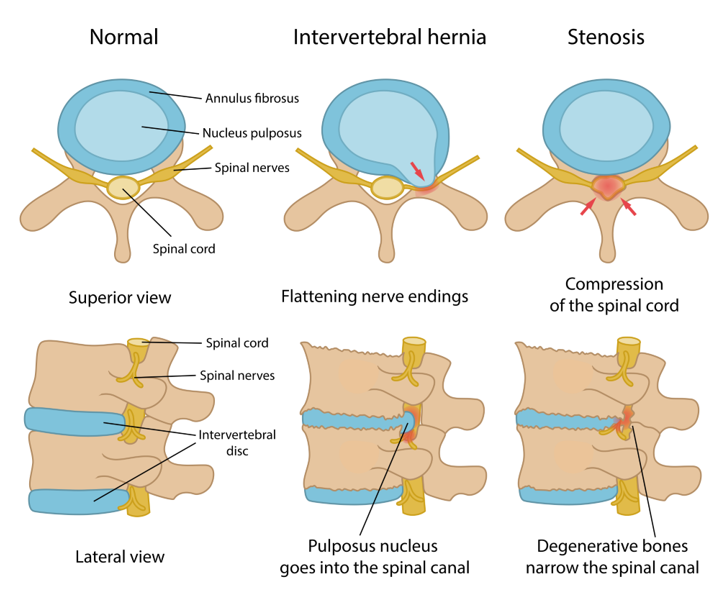
Lumbar spinal stenosis is a condition characterized either by the narrowing of the vertebral canal where the spinal marrow and spinal nerves are housed or by the narrowing of a vertebral foramen - in a normal vertebrae the vertebral foramen is the hole (opening) formed by the anterior segment of the vertebra (the body) and its posterior part (the vertebral arch).
If the narrowing is significant, it can compress the spinal nerves or spinal marrow, which causes pain that can also irradiate in the buttocks, numbness and leg pain, which worsens when walking and attenuates with rest.

The spinal marrow is housed in the vertebral (spinal) canal and stretches from the first cervical vertebra (C1) to the lumbar level (L2). From the level of the lumbar vertebra L2 where it ends, the spinal marrow has a terminal formation called terminal fillum, which together with the roots of the sacral and lumbar spinal nerves form the „ponytail” (cauda equina), called that because it resembles the tail of a horse.
Some people are born with a smaller spinal canal, so they are more prone to spinal stenosis.
One of the main risk factors associated with lumbar spinal stenosis is aging, because it is associated with the degeneration of the spine or osteoarthritis, which can lead to the appearance of osteophytes that also grow in the spinal canal, narrowing it.
Osteoporosis can cause compression fractures of the lumbar vertebrae that lead to spinal stenosis
Also, changes in the position of the vertebrae, such as the slippage of a vertebra can cause spinal stenosis.
Problems of intervertebral discs such as disc extrusion (significant protrusion of the intervertebral disc into the lumen of the spinal canal) or severe disc prolapse can narrow the vertebral canal.
Other, rarer causes are a tumor or a cyst.
Lumbar spinal stenosis can manifest with loss of sensations around the anus or lack of control to defecate (going to the toilet).
More typical symptoms of spinal stenosis include pain and numbness in the leg, walking pain and/or muscle weakness.
Symptoms tend to improve when people lean forward and after rest.
Physical therapy is a very important part of the treatment because patients with spinal stenosis tend to reduce their physical activity in order to avoid pain. But muscle weakness (lack of muscle tone) further accentuates the pain.
Thus, through stretching exercises programs as well as toning exercises of the abdominal and paravertebral lumbar muscles will improve the flexibility and stability of the spine, muscle strength and endurance.
A stronger muscle mass will provide better support to the spine.
It helps reduce the pressure on the spine and can also be useful in cases of intervertebral disc degeneration.
Since the pain is caused by pressure on the spinal nerve, reducing inflammation around the nerve can help relieve pain.
Nonsteroidal anti-inflammatory drugs (ibuprofen, paracetamol, diclofenac etc.) help relieve pain and inflammation, but are recommended for short periods of time, 7-10 days.
If the pain persists, corticosteroid infiltrations around the irritated or swollen nerve root due to compression, help reduce inflammation and will also partially decrease compression. However, repeated infiltrations can weaken bones and tissues in the vicinity, so only a few infiltrations per year are indicated.
It is indicated in severe cases to decompress the spinal marrow and/or nerves by widening the vertebral canal.
➢ Maintaining or decreasing body weight diminishes the loading of the lumbar spine
➢ The use of walking canes or orthopedic frames can decrease pain allowing the body to bend forward.

I always follow professional workflow and provide you the best service with reliable costs.



Low back pain or lower back pain can range from mild to severe; it can be long-lasting or short-lived affecting daily ...
Neck pain (not throat pain) and stiffness can have many causes, but most commonly it is caused by tense and tired ...
Multiple sclerosis (MS) is a potentially debilitating condition of the brain and spinal cord (central nervous system) ...