


2023-03-13 00:00:00
METACARPAL FRACTURE
The metacarpal fracture is a rupture of one or more metacarpal bones and is very common among people who practice ...


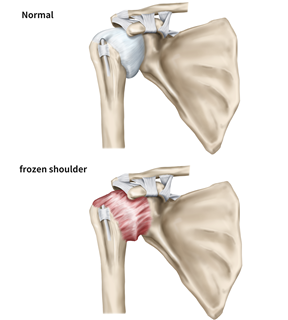
The shoulder joint, also called the scapulo-humeral joint, consists of the humeral head and the scapula (shoulder blade). They are articulated in the joint cavity, and between them there is hyaline cartilage with the role of shock cushioning and reducing the friction of the 2 bone components. The humeral head and the scapula are covered by articular cartilage, an uninervated structure, unvascularized and which ensures the painless mobility of the joint (by lack of innervation). Around the bony ends there is the joint capsule, a cylindrical, fibrous sleeve, consisting of longitudinal fibers located superficially and circular fibers in depth.
Retractile capsulitis represents the retraction (scarring) and thickening of the joint capsule and is manifested by the progressive loss of the joint amplitude and by the appearance of pain.
• Shoulder trauma or surgery, especially if following them the shoulder has been immobilized for a prolonged period of time.
• Certain conditions predispose to the onset of retractile capsulitis, such as endocrine disorders (diabetes, thyroid problems), Parkinson's disease or some heart disease.
• Age, retractile capsulitis sets in after 50-60 years, being more common in women.
1. deaf, persistent pain, which can be accentuated with movement or when the person sleeps on the affected shoulder
2. limiting the movement in the joint
3. difficulty performing movements, such as combing the hair
Retractile capsulitis evolves in three stages, namely:
1. The painful stage, in which the pain is intense and the movement limited, it can last for 6-12 weeks
2. The frozen stage, in which the pain improves but the movement is further limited, it can last for 4-6 months
3. The stage of defrosting, melting, in which the gradual increase of the movement in the joint takes place, but the movement does not fully recover.
1. Medicine treatment, with anti-inflammatories, helps relieve pain and inflammation. It is recommended but in the short term, 10-14 days.
2. Physiotherapy, using procedures such as: ultrasound, laser therapy or thermotherapy significantly helps decontracting.
3. Deep massage and manual therapy are indicated, with beneficial decontracting effects
4. Kinesiotherapy
It pursues the recovery of mobility in the joint and the success of recovery consists in the execution of exercises 2-3 times a day.
Special programs of stretching exercises and active exercises of toning the muscles around the shoulder joint will be executed.
Joint mobilization techniques are used to keep the joint sliding and prevent scar tissue formation.
5. Surgery is considered when the pain does not improve and does not increase mobility in the joint.

I always follow professional workflow and provide you the best service with reliable costs.



The metacarpal fracture is a rupture of one or more metacarpal bones and is very common among people who practice ...
Although pregnancy seems like the perfect time for "laziness", fatigue can be felt more than usual and the back may ...
Luxation of the kneecap is an unusual and quite serious injury. It occurs when the patella has come out of the normal ...