

2023-03-07 00:00:00
COXARTHROSIS
Coxarthrosis is a condition that manifests itself with wear or degeneration of the hip joint. Similar to other joints that ...


The sacroiliac joints are the joints in which the lower part of the spine (sacrum) connects to the pelvis. There are two sacroiliac joints, one on each side, with ligaments in each of them (ligaments are bands of tissue that connect the bones to each other).
It is not clear if the pain begins in the sacroiliac joint or in the surrounding ligaments.
Sacroiliac pain can be difficult to diagnose because other conditions can cause similar symptoms. Sacroiliac pain is most commonly felt in the lower back and buttocks, but it can also be felt in the thigh or leg. But if numbness and tingling or weakness are present, an alternative diagnosis should be considered.
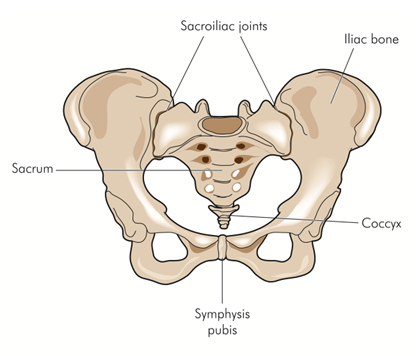
The sacroiliac joint is the joining area between the sacral bone and the ilium bone that are connected to each other by strong ligaments. The sacral bone supports the spine and is supported in turn by the ilium bone, on each side.
Near the sacroiliac joint are the buttock muscles and the pyriform muscle.
The sacroiliac joint is a strong joint supporting the entire weight of the upper body. One of the functions of the sacroiliac joint is the absorption of shocks for the spine.
After birth, but not exclusively then, the sacroiliac joints can become hypermobile or even unstable. This means that the joints move too much and the ligaments do not support them well enough.
Sacroiliac joints can become blocked or stiff.
Stiffness can occur in people who cannot perform the full range of movement in the joint or in people who do not move very much or even in cases of hypermobility, a situation in which the joint may get stuck at the end of the movement range. Stiffness is easy to treat by manual therapy.
Degenerative wear of the sacroiliac joint can cause osteophytes or their inflammation
It manifests itself with pain at the level of the sacroiliac joints but also in other musculoskeletal structures around the joints.
Sacroiliac pain can be aggravated by prolonged sitting in a chair or standing, climbing stairs or running.
The treatment of sacroiliac pain depends on the associated symptoms and the underlying cause of the pain.
Anti-inflammatory and pain relievers help relieve pain, but are recommended for short periods of time, 7-14 days maximum. Injections of corticosteroids (stronger anti-inflammatory) administered locally, significantly reduce inflammation and can be extremely useful in the treatment of chronic Sacroiliac Syndrome. There are also more innovative treatments, such as platelet-rich plasma therapy, which generally consists of injections with a concentration of their own platelets, to accelerate the healing of tendons, ligaments, muscles or injured joints.
Locally applied ice, in sessions of 10-15 minutes, 3-5 times/day, helps reduce inflammation. Always put a thin towel between the ice and the area on which it is applied. Deep heat applied to the painful area also has beneficial effects in relieving pain. To alleviate discomfort, the two forms of therapy, ice and heat, are used alternately.
➢ exercises that aim both at stretching the muscles of the lower back and the buttock muscles (stretching), as well as their toning will be practiced, to ensure support and support of the spine.
➢ improving posture is another objective pursued by the recovery program
➢ learning techniques to protect the spine and the sacroiliac joints (for example, lifting heavy objects is done by bending the knees, as well as in the squat position and lifting the weight by pushing the legs and not by bending the back forward).
A special belt can be worn to stabilize the sacroiliac joint, especially when there is joint hypermobility.

I always follow professional workflow and provide you the best service with reliable costs.



Coxarthrosis is a condition that manifests itself with wear or degeneration of the hip joint. Similar to other joints that ...
The scapular levator syndrome refers to the pain felt in the scapular levator muscle, being one of the most common ...
The tarsian tunnel syndrome is a condition that occurs when there is a high pressure on the nerves located on the ...