


2023-03-23 00:00:00
ELBOW LUXATION
When the articular surfaces at the elbow level become separated from each other, the luxation appears, which can be ...


Ankle sprain is one of the most common orthopedic conditions. It usually occurs suddenly, as a result of a twisting movement of the foot, affecting both the soft tissues and the ligaments of the ankle.
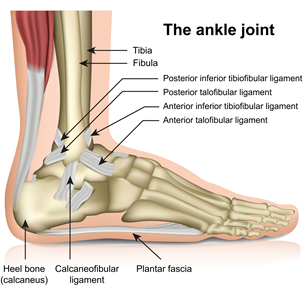
Also called the talocrural joint, the ankle joint is complex, allowing the movement of the foot in all body planes, also having the role of shock absorption and transmission of weight to the plantar support, both in static position and during movement.
The stability of the ankle is given by the ligaments, the bone structure and the supporting muscles.
The role of ligaments is to maintain a normal joint connection by stabilizing the bones of the foot and calf.
Ligaments have an elastic structure that allows stretching and returning to the initial position.The ligaments that support the ankle are the deltoid ligament located on the medial (inner) side of the ankle and the anterior talofibular, posterior talofibular and calcaneofibular ligaments, located on the lateral (outer) side of the ankle.
Sprains occur when ligaments are tensioned over the maximum limits of elasticity (stretching), most commonly during walking or physical activities on an irregular surface. They may tension ligaments until a total rupture is produced.
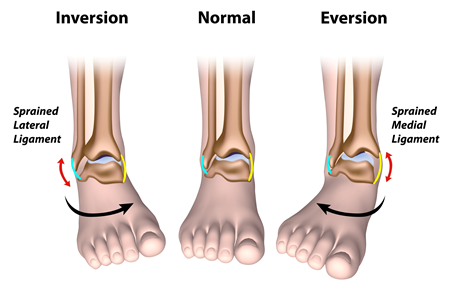
Medial sprains of the ankle occur during charging activities, when a sudden change of direction occurs. The injury occurs due to the extreme turning (twisting) of the ankle outwards, often associated with the rupture of the ligaments on the outside of the ankle. It is also known as an inversion sprain.
The lateral sprains, less common, occur because of the extreme twisting of the ankle inwards causing injury to the ligaments inside the ankle. It usually occurs during landing on an uneven surface or in basketball and is also known as eversion sprain.
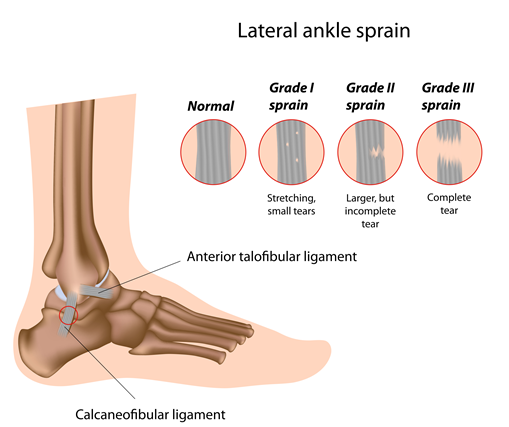
Depending on the severity of sprains, they are classified as folows:
There is minimal damage to the ankle, respectively the slight stretching of the ligaments. It manifests with local pain and tenderness, tumefaction (swelling) and stiffness. There are no signs of ankle instability.
Partial sprawling and tearing of the ligaments occur. It manifests through local ecchymosis (bruising), joint laxity, pain while walking.
The total rupture of the ligaments occurs, manifesting with severe instability at the level of the ankle. Walking is almost impossible, especially due to local pain.
Ankle sprains manifests with the sudden swelling of the foot and ankle associated with their bruising. Sometimes bruises can go up to the level of the calf. Intense pain is present both in orthostatism (impossibility to sit on the affected leg) and during walking and the mobility of the ankle is reduced.
Most of the time surgery is not necessary.
To reduce pain, inflammation and to accelerate the healing process, the following methods are used:
Ice applied topically, in sessions of 5-10 minutes, 3-4 times a day, helps to decrease inflammation. Always apply a thin towel between the ice and the area on which it is applied.
Rest and elevation(lifting) of the affected leg on a support(pillow) helps reduce inflammation and pain.
The use of an ankle pad that achieves local compression helps to heal the ligaments and also to reduce inflammation. Walking will be done with crutches so as not to put pressure on the affected leg.
Sports shoes or flat shoes that support the ankle and foot, are preferable.
Manual therapy and physical therapy are important in the recovery of ankle sprains.
Through stretching exercise programs, muscle toning exercises that support the ankle joint and balance exercises, one can achieve:
➢ reducing inflammation and pain
➢ increasing mobility in the ankle joint
➢ increasing ankle stability
➢ restoration of damaged ligament
➢ prevention of relapses
Normally, an ankle sprain needs about 4 weeks for complete healing but there are also severe cases where the healing process can take up to 3 or 4 months.
➢ Immediately after the recovery period, uneven or slippery terrains will be avoided because relapses of ankle sprains are frequently encountered, a percentage of 75% of sprains relapse.
➢ The ankle pad can also be worn after healing, especially in the case of athletes who need greater freedom of movement, thus supporting the overworked ligaments.
➢ In the case of athletes, warm-up before training and recovery after training have an important role in the prevention of sprains
➢ Shoes also have an important role, both in the prevention of ankle sprains and in the prevention of relapses

I always follow professional workflow and provide you the best service with reliable costs.



When the articular surfaces at the elbow level become separated from each other, the luxation appears, which can be ...
Lymphedema generally refers to swelling of the arms or legs. Sometimes both arms or legs can swell and is most ...
Lumbago is a condition that brings pain in the muscles and joints of the lower back, more precisely in the lumbar area, caused by an ...