Medial epicondylitis or the golf player's elbow is a condition that causes pain in the tendons of the forearm muscles that attach to the medial epicondyle of the elbow (on the inside of the elbow). But the pain can also radiate to the forearm and wrist.
The golf player's elbow (medial epicondylitis) is similar to the tennis player's elbow, also called lateral epicondylitis, which manifests with pain on the outside of the elbow. But there are also tennis players that repeatedly use their wrists or clench their fingers and who can develop the golf player's elbow.
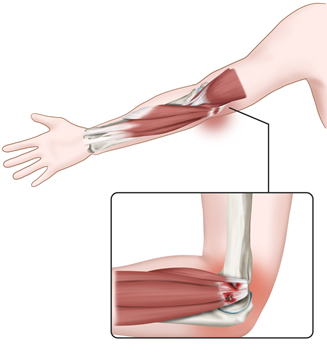
HOW DOES MEDIAL EPICONDYLITIS MANIFEST?
➢ Pain and tenderness felt on the inside of the elbow, pain that sometimes extends along the inner part of the forearm and that worsens with certain movements specific to golf.
Pain can occur suddenly or gradually.
➢ Elbow stiffness
➢ Weakness in the hands and wrists.
➢ Numbness or tingling, which can also radiate to the level of one or more fingers, usually ring and little finger.
The elbow joint consists of three bones:
➢ arm bone: humerus
➢ the two bones of the forearm: radius and ulna.
The distal extremity of the humerus, also called the epiphysis, articulates with the radius and ulna and presents an articular part called the condyle of the humerus and a non-articular part, epicondyle, lateral and medial.
On the medial epicondyle tendons of the affected forearm muscles are inserted in the medial epicondylitis.
Ligaments, muscles and tendons stabilize the elbow joint.
WHAT ARE THE CAUSES OF MEDIAL EPICONDYLITIS?
The main cause is damage to the muscles and tendons that control the wrist and fingers, damage caused by strong and repetitive movements of the wrist and fingers during the game of golf.
Improper lifting, throwing or hitting, short warm-up or lean muscles can also contribute to medial epicondylitis
There are other activities or professions besides golf that can lead to medial epicondylitis:
➢ Sports where the racket is used, more precisely the improper technique of blows in tennis, especially the backhand, can cause tendon injury or the use of a racket that is too small or too heavy.
➢ Throwing sports, more precisely the improper pitching technique in baseball or softball
➢ Football or archery can also cause medial epicondylitis
➢ Lifting weights using an improper technique, such as curling the wrists during an exercise for the brachial biceps, can overload the elbow muscles and tendons.
➢ Strong, repetitive movements in professions such as construction, plumbing and carpentry also overload the muscles that are inserted on the elbow and related tendons.
HOW DO WE TREAT MEDIAL EPICONDYLITIS?
1. REST
Avoid activities or movements that cause or accentuate the pain. In the long term, the pain should not keep the affected person away from activity, which is why rest and proper treatment help to resume activities. Sometimes it is necessary to wear an orthosis to support the affected arm, favoring the faster recovery of the tendon.
2. DRUG TREATMENT
Anti-inflammatory and pain reliever drugs (ibuprofen, paracetamol, etc.) help significantly relieve pain. They are recommended but for short periods of time, 7-14 days maximum.
3. CRYOTHERAPY
Ice applied topically on the affected area, respectively on the inside of the elbow, for 15-20 minutes, up to 3-4 times a day, for several days, helps reduce pain and inflammation. To protect the skin, the ice wraps itself in a thin towel. You can also choose to massage the affected area with ice, for 5-10 minutes, 1-3 times a day.
4. PHYSICAL THERAPY
An exercise program will be started to pursue both stretching and strengthening (toning) the tendon and affected muscles.
The key to healing the tendon is the proper loading of the upper limb through specific strength exercises.
Thus, an exercise program that gradually loads the tendon is essential for its recovery (charging too little does not help the tendon to heal and too much loading will cause the tendon to become further inflamed).
Tendons heal at a double rate than the muscles, but often the symptoms improve quite quickly.
5. SURGERY
It is rarely necessary. If the signs and symptoms do not respond to traditional treatment (described above) in 6-12 months, then only surgery could be an option.
ADVICE:
➢ In order to prevent medial epicondylitis, insist on strengthening the muscles of the forearm by using light weights or squeezing a tennis ball.
➢ Before a physical activity, insist on warm-up and light stretching
➢ In sports activity (golf, tennis) is preferably used a suitable and light equipment, such as graphite golf clubs or a lighter a tennis racket.
➢ When lifting objects or weights, keep the wrist straight and stable to reduce elbow strength.
➢ In the case of practicing a sport, the advice of an instructor/coach is required both to avoid overloading the muscles or tendons and to check/correct the technique
➢ Breaks and rest are necessary when pain occurs in the elbow.