


2023-02-20 00:00:00
ULNAR COLLATERAL LIGAMENT RUPTURES
Ligaments are structures of soft tissues that connect bones to each other.The ulnar ligament is ...


Plantar fasciitis is one of the most common causes that cause pain in the heel. The heel is one of the most overworked areas of the body, because at this level a continuous pressure is exerted during walking and during prolonged standing.
The plantar fascia is a band of tissue that stretches from the level of the fingers to the bone of the heel (calcaneus) that it connects and also forms the arch of the foot. When the plantar fascia becomes too tense, it can pull on the heel bone causing pain and inflammation. Thus, walking or running will be accompanied by pain in the heel.
Repeated physical activity accompanied by tensioning of the plantar fascia can cause tendonitis (inflammation of the tendons), pain and inflammation in the heel and even the appearance of calcaneal spurs (bone protrusions located on the anterior plantar edge of the calcaneus).
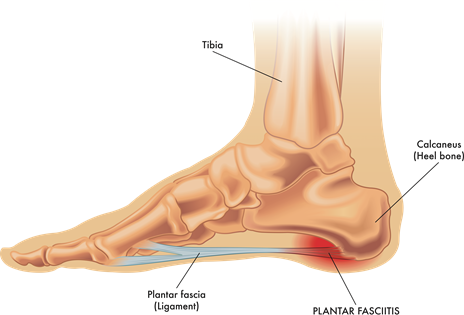
At the level of the legs there are several flexible structures, consisting of bones, muscles, ligaments, joints and other soft tissues that allow maintaining the orthostatic position (standing), as well as walking, running, jumping.
The fingers are numbered from I to V, from the medial edge to the lateral edge of the foot. The first finger is called the hallux, and the V finger is called the little finger. The bones that form the fingers are called phalanges. In total there are 14 phalanges: each finger has three, except for the hallux, which has only two.
It consists of five metatarsal bones, which are long bones and pairs. Their numbering is made from the medial edge to the lateral one of the foot, from I to V, similar to the fingers.
It consists of seven bones arranged on two rows:
➢ a posterior row with two overlapping bones: the talus, located at the top and the calcaneus located below (the talus supports the bones of the foot and the calcaneus is the largest bone of the foot)
➢ an anterior row with the other five bones: the navicular, the cuboid and three cuneiform bones
It rolls along the surface of the foot allowing all the movements necessary to maintain balance and movement. The Achilles tendon is a structure of fibrous tissue that connects the calf muscles to the heel bone (heel) – basically, it connects the calf and the heel. The Achilles tendon is the largest and strongest tendon in the body. When the calf muscles flex, the Achilles tendon presses on the heels, this movement allowing us to step on the tips while walking, running or jumping.
it is important to take the necessary time for recovery. Avoid activities that cause pain in the heel as well as running or walking on hard surfaces.
Locally applied ice helps reduce inflammation and pain. You can put ice in a bag, on the floor and leave the heel on the bag or apply ice on the heels, in sessions of 5-10 minutes, 3-5 times a day. Always put a thin towel between the ice and the area on which it is applied. An alternative is to immerse the heel in a bowl of water and ice.
It has an important role in both the prevention and treatment of plantar fasciitis. It can have a band adapted to individual needs and for people who do sports or run, shoes must be purchased from specialized stores.
Massage, manual therapy and specific physical exercises significantly help:
➢ stretch the plantar fascia
➢ reduce the tension in the fascia
➢ stabilize the foot
Self-massage with the help of a golf ball or squash (the sole is rolled on the ball), also helps reduce the tension in the plantar fascia.
Stretching exercises both at the level of the Achilles tendon and at the level of the sole help to reduce the tension at the level of the plantar fascia.
Electrotherapy, using laser, ultrasound and shock wave therapy, helps reduce inflammation and stimulate the healing process. Shock wave therapy is successful in situations where other therapies fail to show results in treating plantar fasciitis. The shock wave applicator is placed on the heel and a strong compressed air pressure creates a shock wave effect, thus stimulating the healing process of inflammation.
Using special devices (gait scanners and pressure boards) gait analysis is useful because it provides information on the biomechanics of the foot. Many times the problems related to the biomechanics of the foot (flat foot, the tips of the feet oriented inside or outside, the arch of the high foot, etc.) are predisposing or causing factors of the plantar fasciitis.
➢ Avoid running until you can walk 10 km without pain and/or until 4 weeks pass without pain
➢ In the case of overweight people, it is advisable to lose weight to avoid increased pressure in the foot
➢ Plantar fasciitis may occur more frequently in people with flat foot or hollow leg, which is why personalized shoe pads help prevent and/or treat fasciitis
➢ Choosing the appropriate footwear, especially in the case of people who run long distances, has an important role in preventing plantar fasciitis
➢ Prolonged standing, walking and running on hard surfaces will be avoided as much as possible
➢ If it is absolutely necessary to wear high-heeled shoes, a gel pad will be inserted into the shoe, at the level of the heel, to avoid pressure on the heel.

I always follow professional workflow and provide you the best service with reliable costs.



Ligaments are structures of soft tissues that connect bones to each other.The ulnar ligament is ...
Overstrain or alignment problems of the knee structures can cause tensions and/or injuries, both of the quadriceps ...
Nerve roots or spinal nerve roots come out of the spinal marrow through the vertebrae and can be compressed ...