


2023-03-14 00:00:00
STIFF NECK
Stiff neck is a condition in which the neck is painful, tilted and twisted. The head is often tilted laterally towards one ...


Rib injuries generally refer to rib fractures, which represent the rupture of one or more ribs. Sometimes the ribs are not broken, but can be easily cracked, manifesting with pain, but the pain is not as intense as if they are fractured. A jagged edge of a fractured (broken) rib can damage surrounding blood vessels or internal organs such as the lung. Rib injuries often occur in the event of an accident, in case of fall, sports injury (especially in contact sports) or can be caused by the strength of one’s own muscles.
When the bones lose their density, as in the case of osteoporosis or other bone diseases, the ribs can be damaged even by stronger stretching or a severe cough.
Babies and children are much less likely to fracture their ribs because their bones are much more flexible.
The main symptom in the case of broken ribs is pain, which can be accentuated in the following situations:
➢ deep breathing
➢ pressing on the injured area
➢ bending or twisting the body
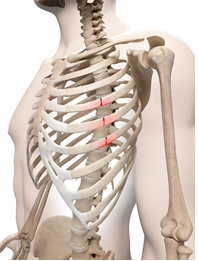

The ribs are flat bones that are part of the chest box, protecting the internal organs.
People usually have 24 ribs (12 pairs), 1 in 500 people having an additional rib, known as the cervical rib.
All 12 pairs of ribs are attached, in the back, to the vertebrae of the thoracic spine, which consists of 12 vertebrae. In the front, most of the ribs are connected to the sternum by means of costal cartilage.
Of the 12 pairs of ribs, the first 7 pairs are called real ribs because they articulate directly with the sternum through their own rib cartilages. The last 5 pairs are called false ribs, of which, 3 pairs of them articulate with the sternum through the 7th rib, while 2 pairs do not articulate with the sternum, which is called floating ribs.
Even if they are fixed, the ribs allow a certain degree of movement, which helps stabilize the chest at exhalation or inspiration.
The ribs are intertwined by the intercostal muscles, and they can also suffer injuries along with rib fractures.
Most of the time, fractures of the ribs heal on their own, in about 4-6 weeks.
Limiting activities that involve the injured area, helps relieve pain but also accelerate healing.
It is important to achieve adequate pain relief to allow deep breathing and coughing. If oral medications, such as: nonsteroidal anti-inflammatories, pain relievers with codeine or paracetamol, do not help enough, one can resort to injections with anesthetics, administered around the nerves serving the ribs.
With the alleviation of pain, breathing exercises that favor deep breathing can begin, which is important because shallow breathing can develop the risk of pneumonia. Also, manual therapy helps destress the intercostal muscles, but also the surrounding muscles.
➢ Avoid compressive bandages around the chest (the technique used in the past to relieve pain) because it prevents the lung from expanding, leading to pneumonia.
➢ Ice applied topically, to the level of the lesion, helps relieve pain.

I always follow professional workflow and provide you the best service with reliable costs.



Stiff neck is a condition in which the neck is painful, tilted and twisted. The head is often tilted laterally towards one ...
Multiple sclerosis (MS) is a potentially debilitating condition of the brain and spinal cord (central nervous system) ...
The name „Skier's thumb” refers to the partial or total tear of the thumb’s ulnar collateral ligament (UCL) ...