


2023-04-10 00:00:00
FRACTURES OF THE FINGERS
Fractures of the hand can occur either at the level of the small bones of the fingers (phalanges) ...


Hallus valgus is a condition of the metatarsophalangeal joint of the big toe, also called hallux, in which the metatarsal 1 (the base of the hallux) moves towards the inside of the foot, which causes the hallux to be pushed in the opposite direction, towards the other fingers. Next to the metatarsophalangeal joint, a bone protrusion is formed, popularly called bunion. In addition, changes in the joints of the 2-5 toes and the limitation of joint mobility may also occur.
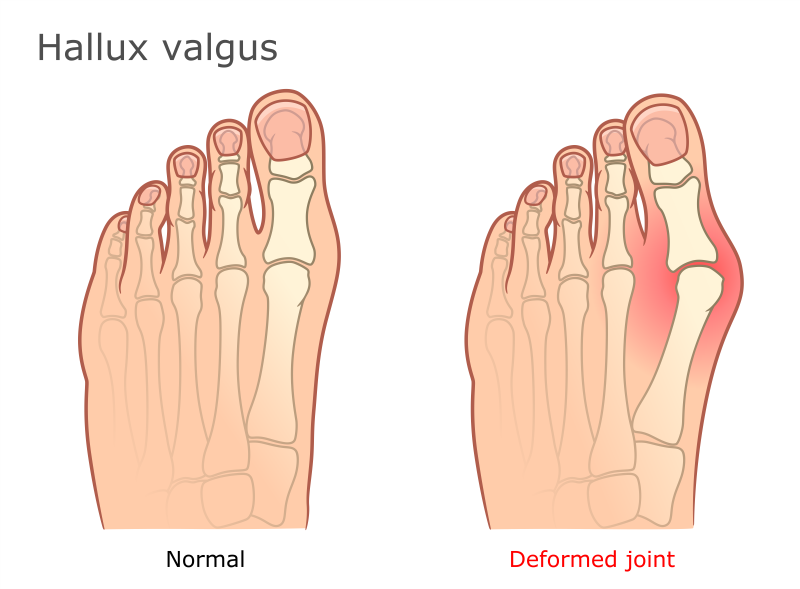
1. Hereditary factors
2. Acquired factors - when there are architectural defects of the anterior part of the foot that cause muscle imbalances and ligamentous laxity
3. Improper shoes - is not a direct cause, but it can aggravate a pre-existing defect
4. Particular ligamentous laxity – is specific to women and is accentuated by hormonal periods (puberty, pregnancy, menopause)
5. Demanding socio-professional activities that require prolonged orthostatism or long-distance travel
6. Certain intense sports activities (athletics, gymnastics)
7. Obesity
First of all, pain appears in the internal side of metatarsal 1, especially when the shoes become uncomfortable, pain that increases with effort and prolonged orthostatism (standing).
The pain can be associated with swelling (swelling of the respective area) and redness but also with numbness or tingling at the level of the anterior part of the leg.
The therapeutic approach depends on its stage or form, because after a certain period of time, Hallus Valgus affection becomes more than a problem of aesthetics of the foot.
When the deviation of the hallux and metatarsal 1 is small and the joint mobility is preserved, the following are recommended:
➢ wearing adequate shoes, which has an wider anterior part
➢ wearing corrective orthotics for the hallux (thumb)
➢ wearing shoes with plantar supporters (personalized pads)
➢ drug treatment with anti-inflammatories, in case of the appearance of bursitis (inflammation of the synovial membrane that can occur as a result of the pressure exerted by the shoes). Sometimes, after the inflammatory episode of the bursitis, at the base of the big toe may remain a endured area, called latent bursitis, which no longer responds to anti-inflammatory treatment. In this situation, surgery is performed to remove the remaining bursitis.
➢ Physical therapy, through special exercise programs, has a significant role in preventing the aggravation of the condition, contributing to:
➢ maintaining joint mobility
➢ increasing the tonus of the involved muscles and relevant structures (tendons, ligaments)
➢ preventing overloading of the thumb
➢ increasing blood circulation
➢ reducing pain
Treatment techniques applied in mild form can prevent the advancement of hallus valgus disease to moderate or severe forms.
The deviation of the hallux and metatatarsian 1 is more pronounced and the joint mobility is reduced and the pain is present both during prolonged orthostatism and at rest.
In the moderate form of hallus valgus disease, surgical intervention is performed.
The pain is constantly present, regardless of the type of shoes worn and the walking is done with difficulty.
Joint mobility is limited by stiffness and bone defects involve the entire anterior part of the foot (it also involves fingers 2-5).
In this situation, the therapeutic approach is also surgical.
Postoperative medical recovery
➢ The recovery program can begin at one week after surgery, through exercises that involve progressive loading of the foot.
➢ Between the medical gymnastics sessions, it is recommended to keep the leg in a proclive position (the lower limb higher, held on a pillow/roll) and massage with ice.
➢ The resumption of professional activity is done gradually, in about 2-4 weeks in the case of office activity and after 8 weeks in the case of activity that requires prolonged orthostatism or sustained physical effort.

I always follow professional workflow and provide you the best service with reliable costs.



Fractures of the hand can occur either at the level of the small bones of the fingers (phalanges) ...
Facial paralysis or facial nerve paralysis means the loss of the ability to move the facial muscles ...
Plantar fasciitis is one of the most common causes that cause pain in the heel. The heel is one of the most overworked ...