


2023-03-28 00:00:00
ATHLETIC PUBALGIA GILMORE’S GROIN
Athletic pubalgia, known as Gilmore's groin, after the surgeon who identified it, is a condition in which the tendons ...


Posterior cruciate ligament ruptures are less common compared to other knee injuries. Together with the anterior cruciate ligament, the posterior cruciate ligament has the role of stabilizing the knee. In case of rupture of any of the 2 ligaments, instability of the knee associated with pain and its swelling (swelling) appears.
Ligaments are bands of strong tissue that connect the bones together, so the crossed ligaments connect the bones of the thigh, respectively the femur, with the bones of the calf, respectively the tibia. The cruciate ligaments, anterior and posterior, form a cross in the central part of the knee.
The posterior cruciate ligament can most often injure or rupture during the practice of a sport, when it is subjected to hyperextension, in case of falling or running into another player. It can also break in case of car accident, if the knee hits the car board.
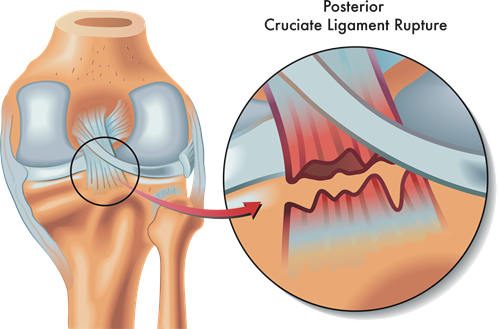
If a posterior cruciate ligament rupture is suspected, tests will be performed to determine the stability of the knee and an MRI examination to confirm the diagnosis.
The duration of the recovery in case of rupture of the posterior cruciate ligament depends on the degree of rupture, so 1st degrees ruptures can recover in about 6 weeks, the 2nd degree ruptures – up to 12 weeks and in case of a 3rd degree rupture, recovery may last between 6-9 months and surgery may be needed.
The knee is one of the largest and most complex joints of the body, having a complex functionality. The knee joint must be mobile and supple to allow flexion and extension of the lower limb and also stable to support the entire weight of the body. Walking, running, jumping, twisting on the heels, braking, stopping, more or less sudden are roles of the knee that generate numerous pressures, managed by the bone, ligamentous, meniscal and muscular structures of the knee. The tendons keep the muscles and bones of the knee connected to allow the knee joint to move.
Anti-inflammatory drugs help reduce pain and inflammation, but are recommended for short periods of time, 7-14 days.
Ice applied topically, in sessions of 5-10 minutes, 3-5 times a day helps reduce inflammation and swelling (swelling) of the knee.
Compressive bandage, applied immediately after injury, helps reduce pain and improves the recovery process.
Physical therapy, through specific exercises programs, toning and stretching, helps:
➢ reduce pain and inflammation
➢ restore the functionality of the joint
➢ tone the stabilizing muscles of the knee. A toned/strong muscle provides both stability to the joint and prevents relapses and/or injuries.
During the recovery process, the knee will be protected with the help of an orthosis or crutches, thus avoiding loading it.
If joint fluid is formed in excess and prevents the restoration of the joint functionality, suction will be used to remove it.
Arthroscopy (a surgical technique) is necessary if the rupture of the posterior cruciate ligament is severe or is associated with other knee injuries.

I always follow professional workflow and provide you the best service with reliable costs.



Athletic pubalgia, known as Gilmore's groin, after the surgeon who identified it, is a condition in which the tendons ...
Carpal tunnel syndrome is caused by compression of the median nerve. The carpal tunnel is a narrow canal, surrounded ...
Inguinal pain is caused by an injury or rupture in any of the adductor muscles which are located on the inside of the ...