


2023-03-14 00:00:00
THE IMPORTANCE OF POSTNATAL EXERCISES
Physical exercise after childbirth represents one of the best things a woman can do for herself. Although it is quite ...


Carpal tunnel syndrome is caused by compression of the median nerve. The carpal tunnel is a narrow canal, surrounded by tendons, ligaments and bones. The median nerve, together with the nine tendons of the muscles that provide the flexion of the fingers, passes through the carpal tunnel and is responsible for the innervation of the thumb, the index, the middle finger and part of the ring finger.
The median nerve is one of the five main nerves that come from the brachial plexus, more precisely, it starts from the lateral and medial cords of the brachial plexus, passes through the anterior part of the arm, forearm and reaches the level of the hand passing through the carpal tunnel.
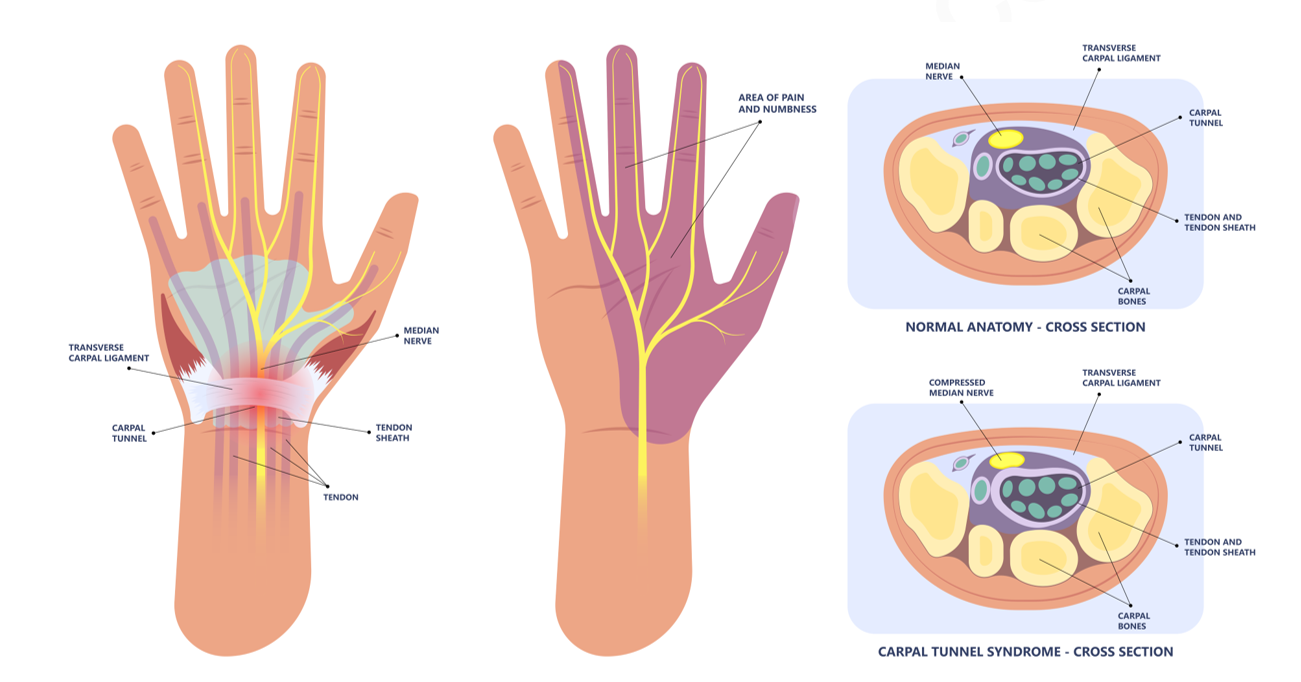
The carpal tunnel syndrome occurs when the tissues surrounding the tendons in the wrist become inflamed (swell) and compress the median nerve. These tissues are called synovial and have a role in lubricating the tendons, thus facilitating the movement of the fingers. The inflammation of the synovial narrows the already small space of the carpal tunnel, in time leading to damage of the median nerve. When the median nerve is compressed, symptoms may include numbness, tingling and pain and a feeling of weakness in the hand.
Also, repetitive movements in the wrist or anatomical changes in the wrist can cause the appearance of carpal tunnel syndrome. Inflammation caused by rheumatoid arthritis or a fracture of the wrist can cause narrowing of the carpal tunnel and implicitly compression of the median nerve.
It is more common after the age of 30, women having a higher risk of developing this condition.
1. A splint or orthosis used during the night to keep the wrist in a neutral position, thus avoiding compression of the median nerve.
2. Interruption of activities that cause or intensify pain, numbness or tingling in the hand
3. Anti-inflammatory medication helps reduce inflammation and pain. Also, local cortisone injections can help reduce inflammation and pain, but symptoms may return after a period of time.
4. Physical therapy, with the help of specific exercises, helps
➢ reduce pain
➢ restorethe normal ability to use the hand
➢ reduce stiffness in the wrist
5. Surgery is indicated when the other forms of treatment don’t show results or in cases with severe and long-lasting symptoms. The objective of surgery is to make more room at the level of the carpal tunnel.
Recovery through physical therapy programs after surgery is necessary to prevent stiffness of the wrist.
✓ Reduce force – if the professional activity involves a keyboard, touch the keys slowly. The keyboard should be at the elbow level or a little lower. In the case of prolonged handwriting, use a large pen with a soft, oversized grip adapter. Take short breaks and relax your hands and wrist.
✓ Alternate activities if possible.
✓ The computer mouse should be comfortable and not depending on the wrist
✓ Maintain a correct posture. Incorrect posture with the shoulders and neck tilted forward can lead to compression of the nerves that start from the neck.
✓ Keep your hands warm because the development of pain and stiffness in your wrist is more common if you are working in a cold environment.

I always follow professional workflow and provide you the best service with reliable costs.



Physical exercise after childbirth represents one of the best things a woman can do for herself. Although it is quite ...
The femur, the thigh bone, is the longest bone in the body, in an adult measuring 40-50 cm. Fortunately, femoral fractures ...
The tibia is the most commonly fractured bone in the whole body and is one of the long bones of the body along with the ...