


2023-03-29 00:00:00
WAIST-BALANCE RATIO
The waist-balance ratio refers to the ratio between the size of the waist circumference and that of the hips ...


Physical exercise after childbirth represents one of the best things a woman can do for herself. Although it is quite difficult to find time for physical exercise, most of the time being dedicated to caring for the newborn, it is still essential to practice. So, either you ask for the support of your partner and family/friends to stay with the baby or the baby is included in the physical activity (in a stroller while walking alertly) or a mattress is used on the floor at home.
Physical exercise after pregnancy may be difficult due to fatigue, hormonal changes, but it can also do wonders both for the loss of the weight accumulated in pregnancy, as well as for the emotional state and can also provide the energy necessary to care for the newborn.
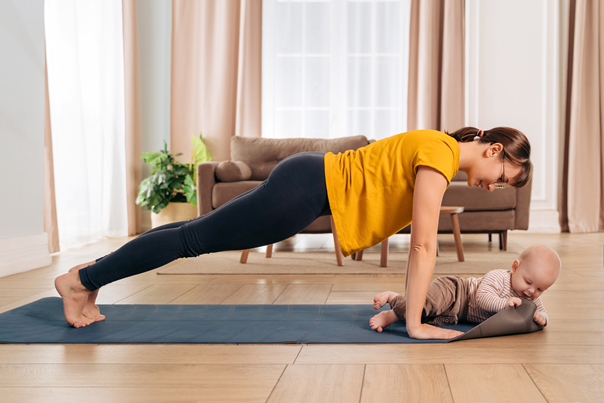
➢ First of all, the restoration of the abdominal muscles
It is the most affected area of the whole-body during pregnancy and it is recommended that in the first 3 months after childbirth to work out especially in this area because it can make the difference between a protruding abdomen and a flat one.
➢ Losing excess weight
The best time to lose excess weight is between the 3rd-12th months after the birth of the baby, since the body has a natural tendency to return to the weight before pregnancy
➢ Regulating the hormonal level
Physical effort is known as a hormone regulator. With its help you can restore the hormonal balance and restore the state before pregnancy.
➢ Improvement in the cardiovascular system
➢ Increased energy levels during the day and better sleep at night
➢ Reducing stress and symptoms of postpartum depression
Moderate exercise does not affect the quantity or quality of breast milk.
What is important to observe when practicing physical exercise during breastfeeding is proper hydration.
More water will be drunk both during training and throughout the day.
There is research that suggests that high-intensity exercise could cause the accumulation of lactic acid in breast milk, which would change the taste of milk, but this is probably rare. But in order to avoid such situations, moderate intensity exercises will be performed.
In order to realize what moderate intensity exercises are, one should be able to have a conversation while performing them (if you cannot speak normally during the exercises, the intensity is probably too high).
If, however, intense physical exercise is a priority in the first months of breastfeeding (there are women who want to resume their performance sports activity), consider feeding the baby before training or milking before training and feeding the baby with milked breast milk. Or, practice physical exercise, take a shower, eliminate a few milliliters of breast milk and wait for 30-60 minutes before breastfeeding the baby.
If the pregnancy was uncomplicated and the birth was natural, it is generally safe to start exercising a few days after birth or as soon as the body is ready.
If, instead, the birth was by cesarean, the physical exercises are usually started after the period necessary for the recovery of the body after cesarean (about 6 weeks). However, in this situation, the doctor's consent is required before starting training.
For most healthy women, at least 150-200 minutes per week of moderate intensity aerobic activity are recommended, spread throughout the week, which means about 20-30 minutes per day.
When making up a training, a few steps will be observed:
➢ workouts start easily and the pace increases gradually.
➢ drink plenty of fluids.
➢ wear a support bra and breastfeeding pads
➢ insist on light warm-up before training (rotating the arms, pelvis, pulling the knees alternately to the chest etc.) and on cooling down (decreasing the intensity and rhythm of the exercises practiced or walking), as well as on stretching movements (stretching) at the end of training
➢ Interrupt the movement if any pain occurs
1. Walking in the form of a daily walk or climbing stairs instead of taking the elevator
2. Gymnastics classes specially designed for the postpartum period (these classes are available at fitness or physical therapy centers)
3. Kegel exercises, extremely useful to tone the pelvic floor muscles, which support the uterus, bladder, small intestine, and rectum (the pelvic floor is greatly strained during the 9 months of pregnancy). To locate the pelvic floor muscles, we imagine that we are trying to stop the flow of urine. Once located, the Kegel exercises are started, which generally consist of following three steps:
➢ Straining (contraction) of the pelvic floor muscles
➢ Maintaining contraction
➢ Relaxation of muscles
Initially, the contraction of the pelvic floor muscles is maintained for five seconds followed by their relaxation for five seconds. If it is too difficult, start with straining and maintaining the contraction of these muscles for two seconds followed by relaxation for three seconds. It is important that the contraction of the pelvic floor muscles is carried out without straining the abdomen, tightening the buttocks or shortness of breath; in other words, only the pelvic floor muscles have to work.
The technique of executing Kegel exercises will improve gradually, initial short repetitive movements being recommended, not numerous, so that in time a contraction of ten seconds is reached, followed by relaxation for ten seconds. The introduction of Kegel exercises in your daily routine (at least three sets of ten repetition) is essential to reduce or prevent urinary and/or incontinence. One series can be done in the morning, upon waking up, another during some relaxing activities (watching a movie) and finally, a series before bedtime.
Avoid practicing Kegel exercises when urinating.
4. Pelvic inclination exercises for toning the abdominal muscles: lying on the floor on the back with the knees bent - lean the back to the floor by straining the abdominal muscles and gently raise the pelvis. Maintain the position for up to 10 seconds and do 10-20 repetitions, ideally five times a day.
5. Specific yoga movements and postures – initially under the guidance of a specialist until learning the correct movements and postures.
As specified in the introduction, exercising after childbirth is one of the best things a woman can do for herself.

I always follow professional workflow and provide you the best service with reliable costs.



The waist-balance ratio refers to the ratio between the size of the waist circumference and that of the hips ...
While many of us believe that sleep is a time when nothing happens, sleep is, in fact, at least from a neurological ...
During each football game the players run, on average, 9.65 km. The origins of football go back over ...