


2023-03-28 00:00:00
HIP PROSTHESIS
A hip prosthesis is a medical device that replaces a damaged hip joint.The hip joint is the largest joint in the body ...


Osteoarthritis is a condition in which the natural cushioning in the joint disappears due to damage to the cartilage and tissue that covers the bone ends that form that joint. Whenever this happens, the bones within the joint end up rubbing closely against each other, causing swelling, pain, stiffness, decreased ability to move, as well as the formation of bone spurs.
Although, most of the times, old age is a major factor in the appearance of osteoarthritis, however, there are also young people who can suffer from osteoarthritis, the main risk factors being:
• Heredity
• A history of knee injuries/joint meniscus injuries
• Inflammatory diseases that also affect the knee joint
• Excess kilograms
Osteoarthritis is the most common of all forms of arthritis, the knee joint is the most frequently affected of all the joints in the body. Women tend to be more prone to this condition, especially after the age of 50.
Usually, due to wear or injury to the joint, the protective cartilage around the knee is damaged, and the bones, in the absence of protective cartilage, rub against each other. This causes inflammation along the articular line. The body tries to protect the area and the joint enlarges, osteophytes (bone spurs) are formed and the capsule around the joint thickens. This causes stiffness, swelling and pain in the joint.
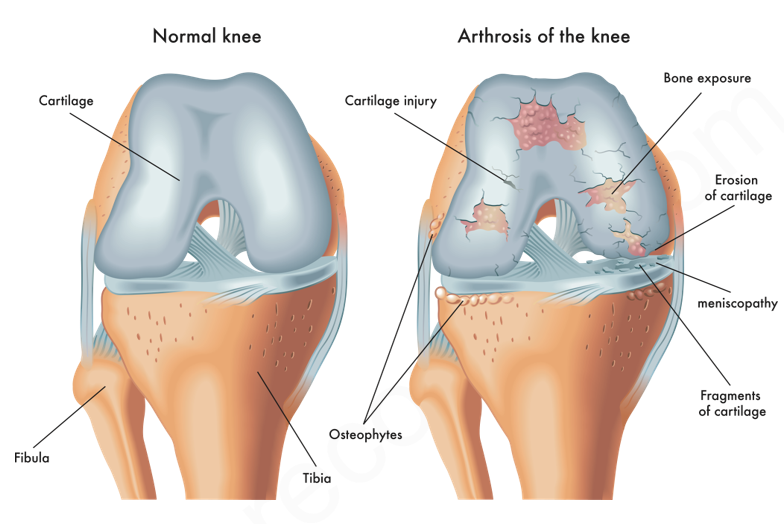
The knee is one of the largest and most complex joints of the body, having a complex functionality.
The knee joint must be mobile and supple to allow flexion and extension of the lower limb and also stable to support the entire weight of the body.
Walking, running and accelerating suddenly, jumping, twisting on the heels, braking, stopping, more or less sudden are roles of the knee, which generate numerous pressures, managed by the bone, ligament, meniscal and muscular structures of the knee.
The bone components that form the knee joint are:
➢ the distal extremity of the femur, represented by the two femoral condyles
➢ the kneecap or patella, which previously unites the femoral condyles
➢ the proximal extremity of the tibia.
On the edge of the bone surfaces there is articular cartilage, a firm, smooth layer of tissue lining all the joints of the body.
Two cartilage discs in the shape of the letter C, form the meniscus, laterally and medially, which allows the knee to move, having a role in the absorption of shocks.
The tendons keep the muscles and bones of the knee connected to allow the knee joint to move.
Ligaments join with all the bones of the knee giving stability to the knee.
Weight loss, if any, can significantly reduce pain in the knee. There are 2 main ways in which excess pounds can lead to the development of osteoarthritis of the knee. The first way involves mechanical forces that act on the joint and the second is based on the development of inflammations. Since adipose tissue is an active tissue, it can stimulate the development of inflammation by producing and eliminating chemicals in the body.
Toning exercise programs for the muscles around the knee significantly help increase joint stability, while stretching exercises help increase the mobility and flexibility of the joint.
The higher the degree of movement in the joint, the more inflammation and pain are significantly reduced.
Local injections of corticosteroids, one of the most powerful anti-inflammatory drugs, help significantly reduce pain in the joint, but the benefits are short-term.
You can choose to wear for a period of time a knee orthosis, which provides support to the joint. This orthosis will also be worn during sports activities.
When necessary, knee arthroscopy is a solution which provides the removal and restoration of the affected cartilage.
✓ Maintain the body weight within normal limits, each extra kilogram adding an additional weight of 3-4 kilograms on the knees.
✓ Avoid repeated activities that involve deep squatting (squatting below 90 °), kneeling, lifting heavy objects.
✓ Avoid running on rough or rough terrain.

I always follow professional workflow and provide you the best service with reliable costs.



A hip prosthesis is a medical device that replaces a damaged hip joint.The hip joint is the largest joint in the body ...
Lumbosciatica or sciatica, is a condition that manifests with pain in the lumbar spine, caused by irritation or compression ...
Since the kneecap serves as a shield for the knee joint, it is quite at risk of injury. Direct fall on the knee, is one of the ...