


2023-03-29 00:00:00
SPINAL STENOSIS
Spinal stenosis is a narrowing of the spinal canal (the canal that houses the spinal marrow) that can put pressure ...


When the knee is significantly affected by an injury or arthritis, some of the simplest activities, such as climbing stairs or walking, will be difficult to perform. The sensation of pain may also be present at rest. If nonsurgical treatments are not fully effective, you may need knee replacement surgery with a prosthesis. This is a safe and effective procedure to help correct leg deformity and reduce pain, thus helping you to return to normal activities.
Knee replacement surgery is one of the successful interventions in the medical field because the surgery technique but also the materials (prostheses) are constantly evolving.
➢ After sports injuries or severe knee injuries
➢ In case of advanced arthritis
➢ Swelling or marked stiffness
➢ Significant pain in the morning, which does not improve during the day
➢ Significant damage to the articular cartilage/degeneration or rupture of the meniscus
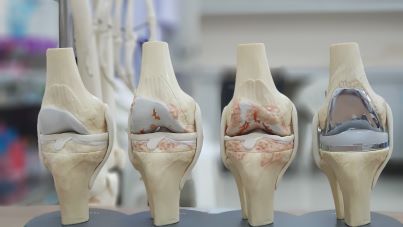
Before undergoing knee prosthesis surgery, a recovery program based on physical therapy, physiotherapy and manual therapy should be tried.
Often, this recovery program is enough to relieve symptoms, exercise significantly contributes to increasing the degree of mobility in the knee joint.
Anti-inflammatory drugs and/or corticosteroid injections, which are powerful anti-inflammatories, can also help reduce pain and inflammation.
If these therapeutic measures do not have the expected results, then knee prosthesis surgery becomes a therapeutic solution.
The knee is one of the largest and most complex joints of the body, having a complex functionality. The knee joint must be mobile and supple to allow flexion and extension of the lower limb and also stable to support the entire weight of the body.
Walking, running and accelerating suddenly, jumping, twisting on the heel, braking, stopping, more or less sudden are roles of the knee, which generate numerous pressures, managed by the bone, ligament, meniscal and muscular structures of the knee.
The bone components that form the knee joint are:
➢ the distal extremity of the femur, represented by the two femoral condyles
➢ the kneecap or patella, which anteriorly unites the femoral condyles
➢ the proximal extremity of the tibia.
On the edge of the bone surfaces there is articular cartilage, a firm, smooth layer of tissue lining all the joints of the body. Two cartilage discs in the shape of the letter C, form the meniscuses, laterally and medially, having a role in the absorption of shocks.
The tendons keep the muscles and bones of the knee connected to allow the knee joint to move.
Ligaments join with all the bones of the knee giving stability to the knee.

1. Preparation of the bone
Damaged surfaces of cartilage, located at the ends of the tibia and femur, are removed with a small part of the bone underneath.
2. Positioning of metal implants
The bone and cartilage that are removed are replaced with the help of metal components that recreate the joint surface.
3. Restoration of the kneecap
The lower surface of the kneecap is cut and restored. The restoration of the kneecap is not always necessary, it depends on each case.
4. Introduction of a spacer
A plastic spacer, of superior medical quality, is inserted between all medical components to create a smooth/clear sliding surface.
POST-SURGERY, the knee cannot bend completely, which is why a RECOVERY PROGRAM WITH PHYSICAL THERAPY is extremely important. One of the great risks after surgery is a very stiff knee due to the hardness of the soft tissues and scar tissue. Full recovery can take up to 18 months, in some cases, even up to about 6 months. The knee is usually able to bend completely after 6 to 12 weeks.
✓ Excessive weight or physical activity can accelerate wear of the knee joint before and/or after the prosthesis is installed
✓ Jogging, jumping, running or other high-impact sports for the knee joint, after the prosthesis is installed should be done with care and under the guidance of the therapist
✓ The best physical activities are: swimming, golf, walking, dancing, cycling and other sports with little impact on the knee joint.

I always follow professional workflow and provide you the best service with reliable costs.



Spinal stenosis is a narrowing of the spinal canal (the canal that houses the spinal marrow) that can put pressure ...
Hallux rigidus (big toe) is actually a form of degenerative arthritis that affects the joint at the base of the big ...
The 12 pairs of cranial nerves represent the routes through which the brain analyzes and controls the information ...