

2023-03-03 00:00:00
ARTHROGRYPOSIS
Arthrogryposis is a term used to describe a variety of conditions that involve joint stiffness (contracture, stiffness) and ...


The brachial biceps muscle is a long, strong muscle, located on the anterior side of the arm. It is inserted on the shoulder blade through two distinct tendons (heads), the long head and the short head. These two heads are joined in the middle of the arm in a muscular body that descends through the anterior lodge of the arm and ends through a tendon that is inserted on the tuberosity of the radius (the radius is a bone of the forearm).
The action of this muscle is complex, it is a powerful flexor of the forearm on the arm but also a supinator of the forearm (movement in which the palm is oriented upwards).
It also contributes to the adduction of the arm and secondarily, it helps in flexion.
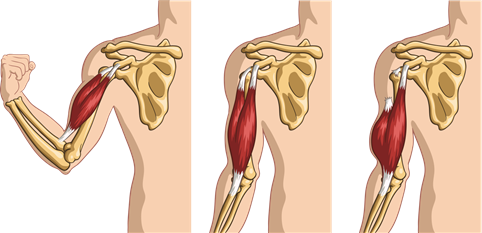
It is rare and often incomplete. For restoration of the muscle fibers, immobilization is recommended, for 3 weeks, with the elbow joint flexed at more than 90 degrees.
After immobilization, it is recommended to start a physical therapy program that will include passive and active exercises.
It occurs after a sudden contraction of the biceps, either during improper training or due to fatigue. Rupture of the proximal tendon occurs more frequently in people between the ages of 40 and 60, who already have a history of shoulder problems and usually affect the dominant arm.
Rupture can also occur in young people in the case of a fall on the outstretched arm or in the case of sports such as football or snowboarding.
✓ age, older people are more prone due to wear of the tendons
✓ overstrain the shoulder, associated injuries such as tendonitis, damage to the rotator cuff, increased stress on the biceps tendon
✓ smoking, nicotine affects the nutrition of the tendon
✓ corticosteroids, can weaken the muscle and tendon
The main symptom is acute pain, felt in the anterior part of the shoulder, pain that can intensify during the night.
For a correct diagnosis, it is important to evaluate the shoulder and arm, tracking the muscle strength as well as the range of movement in the shoulder and elbow joints, but also other specific tests.
Anti-inflammatory drugs are recommended for the underlying anti-inflammatory process that predisposed to tendon rupture, but also to reduce pain and inflammation.
It is indicated only for young, athletic people and for people who need maximum resistance to supination, that is, people who do manual work, such as carpenters.
It consists of a tenotomy that includes attaching the torn tendon to the bone, with good results in full functional recovery and muscle strength.
Rupture of the brachial biceps can lead to the loss of 20° of the supination movement of the forearm (the movement of the orientation of the palm upwards) but this rarely affects the daily activities, except for people who do manual work.
It has an important role both in the traditional treatment (without surgery) and after surgery.
If you do not opt for surgery
Recovery lasts on average 4-8 weeks, during which the physical therapy program is performed 3-4 times/week and includes:
✓ exercises to increase the mobility of the shoulder joint
✓ stretching exercises
✓ strength exercises to increase muscle tone
After a period of 2-3 weeks, when the pain will decrease in intensity and the strength of the muscle will be better, professional activities can be resumed but adapted to the medical condition.
After a period of 8 weeks from the beginning of the recovery program, the muscle will completely regain its functionality but the popeye sign will remain visible (the muscle mass partially descends to the lower part of the arm giving the region a special, more prominent shape, similar to the image of Popeye the sailor, from where the name of the popeye sign came from).
If you opt for surgery
The recovery program will be as follows:
➢ In the first 10-14 days after surgery, a harness (mastersling) will be worn, during which you can do passive exercises.
➢ in weeks 2-6, light exercises are performed, after which progress is made to functional exercises
➢ after 8 weeks, moderate loading of the muscle is allowed, and heavier loading is done after at a few months after surgery.

I always follow professional workflow and provide you the best service with reliable costs.



Arthrogryposis is a term used to describe a variety of conditions that involve joint stiffness (contracture, stiffness) and ...
Facial paralysis or facial nerve paralysis means the loss of the ability to move the facial muscles ...
Osteochondrosis is a condition caused by wear of the intervertebral disc and adjacent vertebrae, due to severe ...