


2023-03-07 00:00:00
KYPHOSIS
The spine has 4 physiological curvatures: cervical, thoracic, lumbar and sacral. These curvatures increase the strength ...


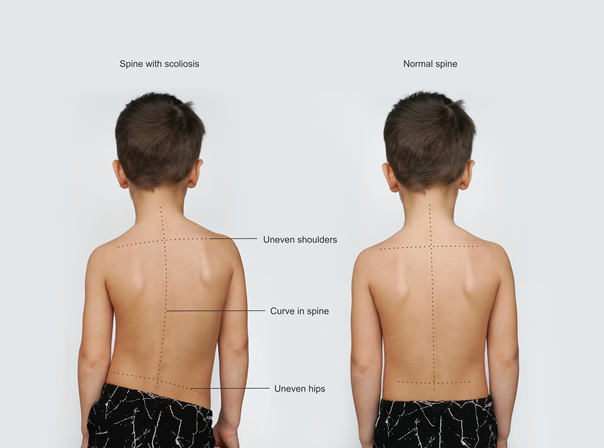
Scoliosis is a condition in which the spine presents a lateral curvature, in the form of the letter S or C, a curvature that can evolve over time. Scoliosis affects over 3% of the world's population and usually occurs at the ages between 10 and 20 years or in case of the elderly who have various degenerative diseases, such as osteoporosis (decrease in bone density).
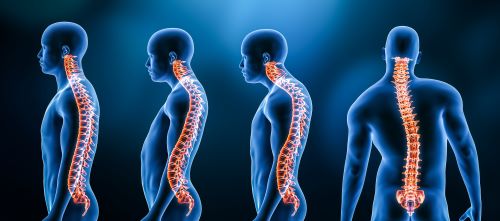
Curvatures of the spine, lower than 10 degrees, are considered normal deviations of the spine. Mild to medium scoliosis may not manifest with intense symptomatology, while severe scoliosis can affect breathing, heart, digestive system and especially cause pain.
The spine consists of a number of 33 -34 small bones, called vertebrae that allow the movement of the spine, namely: flexion - extension, rotation and lateral inclination.
The vertebrae are connected to each other, thus creating the vertebral canal in which the spinal marrow is housed and protected.
Spinal nerves protrude from the spinal cord and form peripheral nerves that cross different parts of the body. A scoliosis can cause the brushing of these peripheral nerves.
The intervertebral discs are structures of fibrocartilaginous nature, placed between two vertebrae. They are essential for the movement of the spine and act as a ligament, tying one vertebra to the next, but they have a role in the absorption of shocks significantly diminishing the impact between the vertebrae.
➢ genetic factors and hereditary factors (generally girls are more prone to the development of a scoliotic curvature)
➢ a small imbalance in the lower limbs, caused for example, by a slight ankle sprain, can predispose the curvature of the spine
➢ a slight difference in height or position of the pelvis can contribute to the onset of scoliosis
➢ certain sports, especially those that use only one part of the body, such as golf for example, predispose to scoliosis
➢ developmental problems - when scoliosis develops in children, increased attention should be paid because it can betray a developmental problem.
Sometimes, scoliosis appears as a secondary manifestation, for a short period, in conditions such as: acute muscle contractions or herniated discs. In this situation, the spine will curve laterally, to remove the pressure from the painful side of the back. As the symptoms of the underlying condition improve, scoliosis also improves until complete correction.
At a specialized consultation, accompanied by an x-ray, the curvature of the spine can be easily observed as well as the asymmetry at the level of the shoulders and hips.
It is used to stop the progression of curvature, especially when the curvature is between 25-40 degrees and when the bones are still growing (in children and adolescents). There are orthopedic corsets that are worn only at night and orthopedic corsets that are worn all the time.
It is the basic element of reducing the curvature but also of preventing its aggravation.
Specific recovery programs are recommended, which include corrective postures, stretching exercises, active exercises to correct the curvature. All these exercises and corrective postures combined with manual therapy help:
➢ to reduce the curvature
➢ to increase the flexibility of the spine
➢ to increase the tone of the paravertebral, abdominal and buttocks muscles (it represents the stabilizing muscles of the body)
➢ to improve breathing
It is indicated if the scoliotic curvature exceeds 40-50 degrees, the main purpose being to prevent a curvature larger than 40-50 degrees but also to correct the curvature with the help of metal rods.
➢ Maintain a correct posture at the desk or on the school bench, with both elbows on the desk/bench and shoulders on the same line.
➢ The satchel should be carried on both shoulders.
➢ Exercise daily, on a regular basis, to minimize pain and discomfort

I always follow professional workflow and provide you the best service with reliable costs.



The spine has 4 physiological curvatures: cervical, thoracic, lumbar and sacral. These curvatures increase the strength ...
Multiple sclerosis (MS) is a potentially debilitating condition of the brain and spinal cord (central nervous system) ...
Ligaments are structures of soft tissues that connect bones to each other.The ulnar ligament is ...