

2023-04-10 00:00:00
GLENOHUMERAL INTERNAL ROTATION DEFICIT
The glenohumeral internal rotation deficit is simply a loss of the internal rotational movement of the shoulder ...


Guyon canal syndrome is a nerve compression that affects the ulnar nerve (cubital) while passing through a tunnel in the wrist, a tunnel called Guyon's canal.
The ulnar nerve starts at the level of the lateral side of the neck, moves on the arm and forearm through the back of the elbow and ends at the level of the hand, more precisely at the little and ring finger.
The symptoms of ulnar nerve compression range from small tingling /stinging in the little and ring finger to the loss of any sensation in these fingers, as well as the impairment of the motor functions of the intrinsic muscles of the hand (which are innervated by the ulnar nerve).
Guyon canal syndrome is often found in people who ride bicycles regularly due to prolonged pressure on the Guyon canal, while holding their hands on the handlebars of the bike.
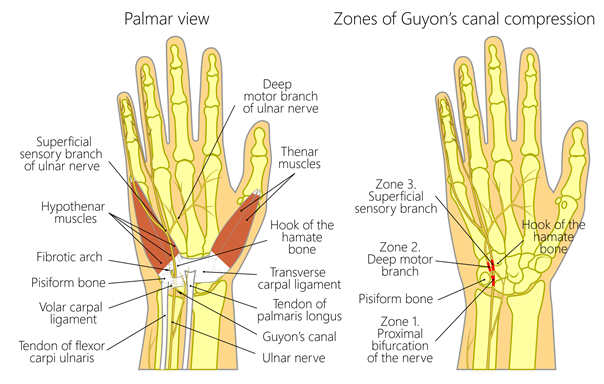
The ulnar nerve begins at the base of the neck, where the individual nerve roots protrude from the spine, through small spaces between the vertebrae.
After leaving the side of the neck, the ulnar nerve passes through the armpit and then through the arm, to the hand and fingers.
At the level of the wrist, the ulnar nerve and the ulnar artery pass through a tunnel known as the Guyon canal.
This tunnel is formed between two bones (pisiform and hamatum) and the ligament that connects them. After passing through the canal, the ulnar nerve branches off by innervating the little finger and half of the ring finger. The branches of this nerve also innervate the small muscles in the palm and the muscle that pulls the thumb towards the palm (polycystic adductor).
➢ overloading the wrist by catching heavy objects, twisting and repeated hand movements the
➢ constant pressure on the palm, common in cyclists and weightlifters, due to the pressure of gripping the handlebars of the bike and weights
➢ constant pressure on the palm when using crutches for walking
➢ a traumatic injury to the wrist
➢ fracture of the hamatum bone (one of the 2 bones that form the Guyon canal) can compress the nerve when passing through the channel. This bone is sometimes fractured when golfers hit the ground instead of the golf ball.
➢ ganglion cysts are a common cause of non-traumatic Guyon canal syndrome.
The manifestations of Guyon canal syndrome begin with a sensation of tingling and/or stinging in the ring finger and little finger, especially in the early morning.
Symptoms can progress to pain, felt as a burn both in the wrist and in the hand, followed by low tenderness in the little and ring finger.
The weakness of the small muscles in the palm of the hand and the muscle that pulls the thumb into the palm of your hand. The progressive weakness of these muscles makes the parting of the fingers and pinching with the thumb difficult. The affected hand can become "clumsy" when these muscles controlled by the ulnar nerve become weak.
Avoid activities or movements that cause nerve compression.
More specifically, repetitive hand movements, catching heavy objects or supporting the hand on hard surfaces will be avoided.
Wearing a splint for the wrist can sometimes reduce symptoms, especially in the early stages of Guyon canal syndrome.
The splint holds the wrist in a resting position (the hand does not lie down too much outside or inside), being necessary both at night but especially during the day, to calm the symptoms and to rest the anatomical structures in the canal.
After a period of 4 to 6 weeks, the splint can be worn only at night.
Anti-inflammatory drugs (ibuprofen, aspirin etc.) can help control symptoms, but are recommended for short periods of time, 7-14 days maximum.
The main objective of the recovery program is to reduce or eliminate the pressure on the ulnar nerve.
Thus, you need to learn the positions in which you have to hold the wrist but also the exercises necessary for the decompression of the ulnar nerve, as well as for the prevention of relapses.
Also practice exercises aimed at strengthening and stabilizing the muscles and joints of the hand, as well as exercises to improve motor control and dexterity.
It’s necessary only if the symptoms do not improve through the other forms of treatment and consists in improving the tension of the ligament that forms the Guyon canal (basically the ligament is cut) and thus reducing the compression felt on the ulnar nerve.
After surgery, a program of active exercises and stretching exercises is also required to increase the mobility of the hand.
➢ People who constantly use the bicycle must take into account several aspects, both in terms of its setting (the height at which the saddle rises, the position of the handlebars) and the position of the body on the bike. In this regard, the advice of a cycling coach can be sought.
➢ If symptoms appear while using the bike, firstly, the duration of pedaling is reduced because long cycling periods tend to exacerbate these symptoms, secondly, try to use a vertical handlebar because it reduces the pressure on the wrist and thirdly, ride the bike on smooth roads.
➢ Avoid excessive use of the wrist or placing unjustified pressure on the palm of your hand
➢ Minimize the time during which activities that require flexion and rotation of the wrist are performed
➢ People who use the keyboard for many hours a day must constantly rest their wrist to prevent or minimize symptoms.

I always follow professional workflow and provide you the best service with reliable costs.



The glenohumeral internal rotation deficit is simply a loss of the internal rotational movement of the shoulder ...
The anatomy of the hand is complex, its integrity being absolutely essential for daily functioning. The hand consists of ...
The cubital tunnel syndrome occurs when the ulnar nerve in the arm, also called the cubital nerve, is irritated or ...