


2023-03-14 00:00:00
THE IMPORTANCE OF PRENATAL EXERCISES
Although pregnancy seems like the perfect time for "laziness", fatigue can be felt more than usual and the back may ...


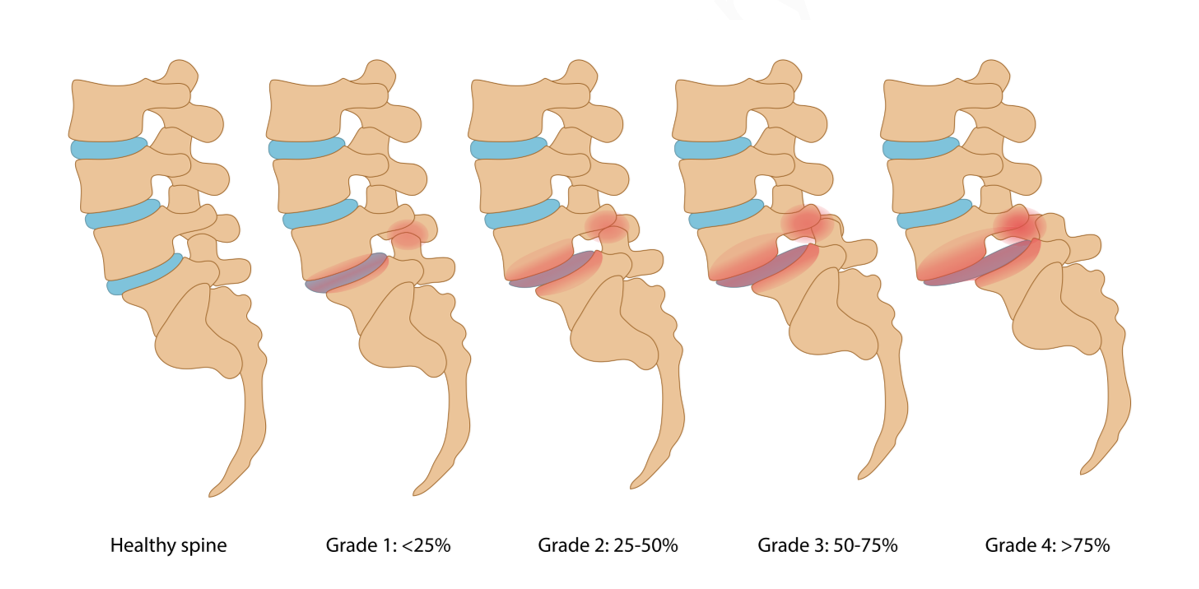
Spondylolisthesis is a condition of the spine that causes low back pain.
It occurs when one of the vertebra slips out of its place on the vertebra below it, which leads to the instability of the spine and can also put pressure on a nerve, causing the irradiation of pain down on the lower limb.
Spondylolisthesis is a common cause of back pain, but it is not a serious condition, there are several therapeutic options for treating it, from medications and physical therapy for less severe cases (1st and 2nd degree) to surgery for severe cases (3rd and 4th degree).
A vertebra is made up of different sections. Between the back and front of the vertebra there is a "bridge" known as pars interarticularis.
Due to repeated stress on the spine, this part of the vertebra may suffer a stress fracture or a crack, which is known as spondylolisthesis.
It occurs when the child's spine is not formed properly in intrauterine life.
Usually, a result of repetitive trauma or overstrain in the spine, frequently found in adolescent athletes.
The most common type of spondylolisthesis and is caused by aging. Over time, the discs between the vertebrae degenerate (become dehydrated, thin) which causes the vertebrae to slip out of their place). It usually occurs after the age of 50 and affects women more often.
Caused by a sudden injury or trauma to the spine, such as a fracture, this is often the result of an accident.
It occurs as a result of a condition such as osteoporosis or a localized lumbar tumor.
Overstrain of the spine is one of the main causes of spondylolisthesis in young athletes, as well as certain forced stretching movements of the lumbar spine, as it happens in gymnastics. The slippage
of the vertebra tends to occur especially during periods of growth, being one of the most common reasons for back pain in adolescents.
Genetics can play an important role as well. Some people are born with thinner vertebral bone.
In older adults, wear of the spine and intervertebral discs (pillows between the vertebrae) can cause this condition.
Low back pain is usually the main symptom, pain that can irradiate in the buttocks and thighs.
The following are also possible:
➢ Muscle spasms in the muscles located in the back of the thighs (femoral biceps, semimembranosus and semitendinosus)
➢ Stiffness in the back
➢ Difficulty to walk or stand for long periods of time
➢ Numbness, weakness or tingling in the leg
But there are also situations in which there are no symptoms.
Treatment depends on the degree of slippage of the vertebra, the present symptoms, as well as age and general health.
For a period of time, intense physical activities, as well as sports activities will be interrupted.
Anti-inflammatory drugs help relieve pain, but are recommended for short periods of time, 7-14 days maximum.
If the pain does not improve significantly, local injections with corticosteroids (stronger anti-inflammatories) can help.
One can perform exercise programs aimed at toning the muscles of the lower back and abdominal muscles, but also at increasing the flexibility of these muscle groups through progressive stretching exercises.
In the case of children and athletes, especially if the cause is traumatic, wearing an orthosis or a detachable orthopedic corset can limit movement in the affected area, accelerating healing.
It’s indicated in severe cases of spondylolisthesis, 3rd and 4th degrees, when the pain is very intense. It often involves the decompression of the spine, with or without fusion. During the simple decompression, the slipped vertebra is removed and thus space is provided to the nerves inside the spinal canal, relieving pain.
In the fusion decompression, the two affected vertebrae are connected (the vertebra that slipped and the one under it). As they heal, the 2 vertebrae will form a single one, eliminating the movement between them.
Physical therapy programs should also be performed after surgery to increase flexibility in the lumbar spine and toning the muscles that support the lumbar spine (abdominal and paravertebral muscles).
In order to reduce the risk of the disease or the risk of relapses (it can happen only in severe cases of spondylolisthesis), the following are recommended:
➢ constant practice of physical exercises for toning (strengthening) the abdominal muscles and lower paravertebrals
➢ maintaining body weight within normal limits, excess weight puts extra stress on the lower back
➢ choosing a balanced diet to keep bones strong
➢ proper warm-up before intense physical training, especially in sports such as gymnastics, athletics or weightlifting, which put a large amount of stress on the lower back
➢ taking breaks between periods of intense physical activity to prevent excessive use of the back and the appearance of stress fractures
➢ avoiding exaggerated stretching (exaggerated stretching movements) of the back.

I always follow professional workflow and provide you the best service with reliable costs.



Although pregnancy seems like the perfect time for "laziness", fatigue can be felt more than usual and the back may ...
The tibia is the largest and strongest bone of the calf bones, the other being the fibula or the peroneum. The tibia connects ...
The sacroiliac joints are the joints in which the lower part of the spine (sacrum) connects to the pelvis. There are two ...