


2023-03-28 00:00:00
ATHLETIC PUBALGIA GILMORE’S GROIN
Athletic pubalgia, known as Gilmore's groin, after the surgeon who identified it, is a condition in which the tendons ...


Cervical pain occurs more often than we imagine. A lot of factors can cause cervical pain, but this is often attributed to aging.
Like the rest of the body, the cervical spine deteriorates as time goes on.
It occurs when the joints at cervical level degenerate and are usually associated with chronic pain. It is estimated that people older than 60 years of age suffer from cervical spondylosis in a percentage of 85%.
Cervical spondylosis is a degenerative condition that manifests through an abnormal wear of the cervical spine and is, in most cases, the effect of an incorrect position of the spine. The disease has a slow evolution and increases with age and the process of vertebral degeneration is the result of wear of the cervical spine.
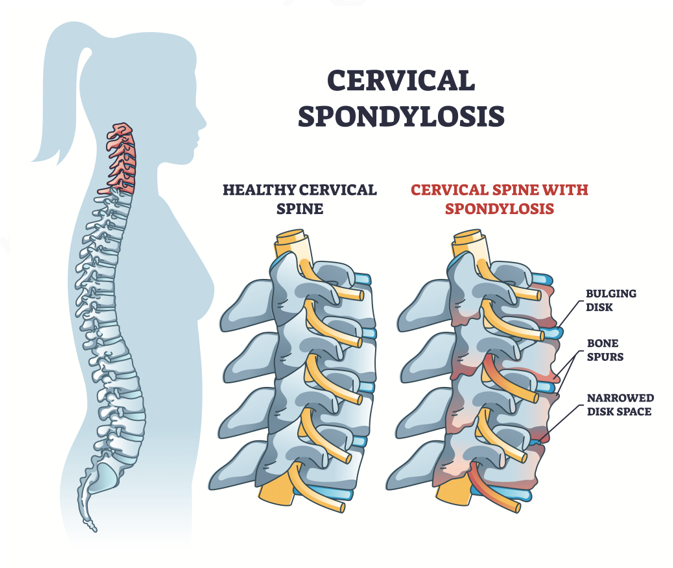
The cervical spine is composed of seven vertebrae that stretch from the base of the skull to the upper part of the thoracic spine.
The first 2 cervical vertebrae are different in shape and function, the first also called atlas, on which the skull is supported, allow the forward-backward movement of the head. The second cervical vertebra, also called axis, allows rotational movement. The other 5 vertebrae support the weight of the head.
Around all the vertebrae there are ligaments and muscles that ensure stability and movement, as well as blood vessels and nerves.
Nerves start from the base of the skull and transmit information between the brain and the body.
Between the vertebrae there are intervertebral discs with the role of cushioning the spine.
Inside the spine there is the spinal marrow.
The main cause is the wear of the discs and articular facets. The abnormal wear of the cervical spine appears after some vicious movements repeated over time, being accentuated by several factors:
➢ dehydration of the intervertebral disc
➢ the aging process
➢ traumas in the cervical spine
➢ incorrect posture
➢ sedentary lifestyle
The diagnosis is pronounced after a specialized examination accompanied by an X-ray or an MRI scan to eliminate other conditions that may manifest similarly.
Avoid activities that cause or accentuate pain
Drug treatment with anti-inflammatories helps relieve pain, but is recommended for short periods of time, 7-14 days maximum.
They are important for:
➢ joint clearance, by removing the pressures that the articular faces exert on the nerve roots
➢ physiological repositioning of the articular surfaces as close as possible which indirectly helps cancel the stimuli that induce pain and muscle contracture
Through programs of specific toning exercises (strengthening) of the paravertebral muscles, stretching exercises and relaxation exercises for the muscles, physical therapy helps:
➢ reduce the compression and irritation of the intervertebral discs
➢ relieve pain
➢ relax and tone the muscles
➢ increase joint mobility
✓ Be active, introduce physical exercises in the daily activity
✓ Ask the advice of a physical therapist for drawing up a program of specific exercises
✓ Maintain a correct posture of the head and neck
✓ During sleep the head must be in a neutral position, have a single pillow under it
✓ Maintain a correct position at the desk, place the computer so that you do not have to tilt the head forward so much.

I always follow professional workflow and provide you the best service with reliable costs.



Athletic pubalgia, known as Gilmore's groin, after the surgeon who identified it, is a condition in which the tendons ...
While practicing a sport, one or more of the components of the musculoskeletal system may suffer injuries, the ...
The maximum heart rate is defined as the highest number of beats per minute that the heart can pump under ...