

2023-03-07 00:00:00
WHAT NOT TO DO IN CASE OF KNEE PAIN
The knee is one of the largest and most complex joints of the body, having a complex functionality. The knee joint ...


Tendinopathy is a condition of the tendons, whose role is to connect the muscles to the bones, often near a joint.
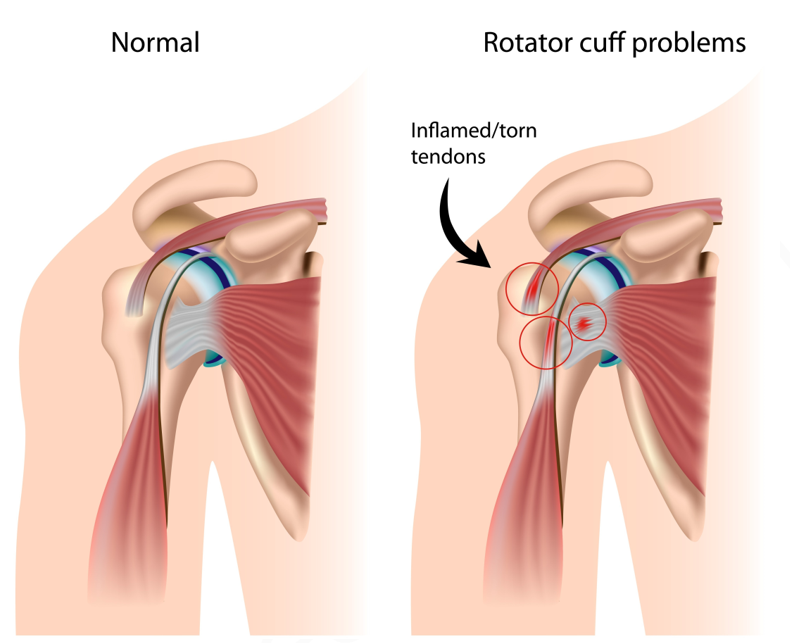
Shoulder tendinopathy (injury of the shoulder tendons) is manifested with pain, swelling and difficult movement. Tendons can become inflamed, a condition known as tendonitis or they can suffer small cracks in the tendon tissue without inflammation, a condition known as tendinosis.
At the level of the shoulder there are several tendons that fix the head of the humerus (the main bone of the arm) in its position, in the glenoid cavity of the shoulder. Injuries to the tendons of the shoulder are often caused by overworking of the shoulder, especially due to repeated throwing movements or movements that unfold above the head. As time passes, the pressure placed on the tendons can cause structural changes inside them.
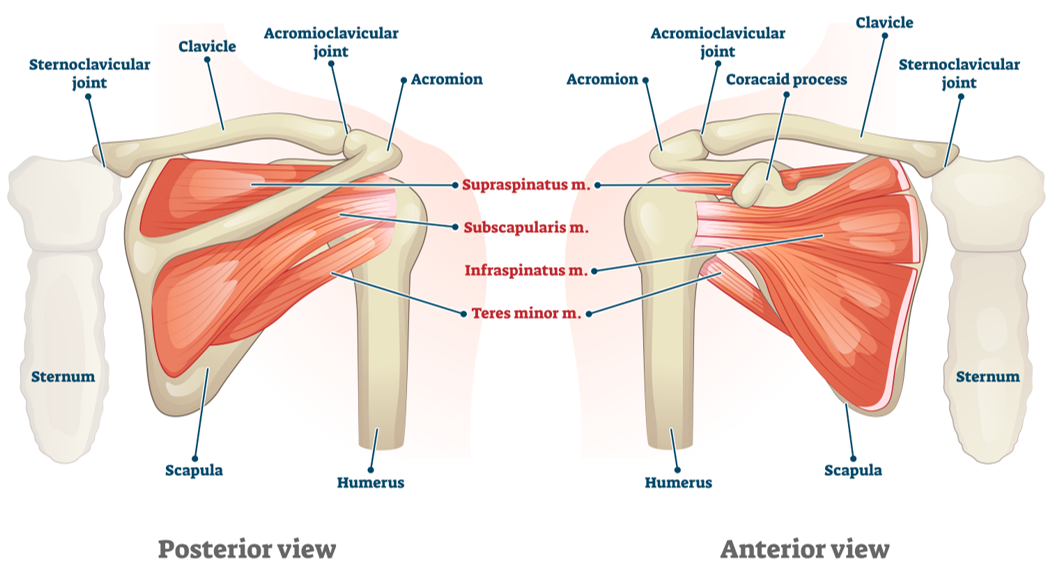
The shoulder is a very flexible joint, ensuring the high-amplitude movements of the arms, which it orients in all directions. The shoulder thus allows most gestures in everyday life, such as: eating, writing, washing etc. In other words, keeping the mobility of the shoulder and its stability are very important.
The component bones of the shoulder joint are:
➢ The humerus, is the main bone in the arm
➢ The scapula or shoulder blade, is a flat, triangular bone, located in the posterior part of the shoulder. The upper part of the scapula is formed by the acromion
➢ The clavicle bone (it is a long bone that connects the scapula to the sternum)
Most of the stability of the shoulder is provided by the surrounding skeletal muscles, with the help of associated tendons and various ligaments.
Most commonly, tendinopathy affects the tendons of the 4 muscles that form the rotator cuff, and especially the tendon of the supraspinous muscle whose function is to stabilize the shoulder and help raise the arm to the side.
When the tendons suffer excessive repetitive stress, they can become weakened and thus tendinopathy occurs. Sometimes inflammation in the tendons can also be associated, sometimes not.
The tendons of the rotator cuff muscles are also susceptible to degenerative changes, especially after the age of 50. A degenerated tendon is at a higher risk of developing tendinopathy and/or a crack.
Avoid or limit activities that cause or accentuate shoulder pain, especially repetitive movements in certain sports, such as tennis, basketball, swimming, golf etc.
Ice applied topically, in sessions of 5-10 minutes, 3-5 times a day, helps significantly reduce inflammation and pain. Always put a thin towel between the ice and the area on which it is applied.
Anti-inflammatory drugs in the form of pills or ointments applied topically, help relieve pain. Injections with corticosteroids, which are stronger anti-inflammatory, administered in the bursa of the rotator cuff, help to decrease inflammation. The bursa is a small sac with fluid, with a lubricating role, which is located between the acromion bone and the tendon of the supraspinatus muscle (muscles that are part of the rotator cuff) and which allows the tendons to move freely, thus avoiding rubbing the tendon on the bone.
Physical therapy, through special exercise programs, is essential for:
➢ toning (strengthening) the muscles that control the shoulder, which contributes to increasing the stability of the shoulder joint
➢ maintaining the normal range of movement in the shoulder joint, which contributes to maintaining shoulder mobility.
➢ The resumption of daily and sports activities is done gradually, in order to prevent further complications.
➢ The exercises of toning the stabilizing muscles of the shoulder will be continued regularly. The duration and intensity of the exercises are increased by a maximum of 10% weekly.
➢ The pain will not be ignored if it reappears at the level of the shoulder, a situation in which the movements that cause or accentuate the pain will be limited.
➢ Excessive use of the arm in movements that take place above the head will be avoided, as this will cause relapses or other conditions.

I always follow professional workflow and provide you the best service with reliable costs.



The knee is one of the largest and most complex joints of the body, having a complex functionality. The knee joint ...
The vertebral spine has 4 physiological curvatures: cervical lordosis, thoracic kyphosis, lumbar lordosis and ...
Morton’s neuroma is a painful condition that affects the flat part of the foot, at the level of the metatarsus, usually ...