


2023-03-29 00:00:00
WAIST-BALANCE RATIO
The waist-balance ratio refers to the ratio between the size of the waist circumference and that of the hips ...


Why is it important to choose the right shoes?For the health of the feet, first of all.
Before buying a pair of new shoes, the length and width of the legs are measured, at the end of the day, in an orthostatic position (standing). For the legs that have high or flat or raised arches (the internal part of the foot), the advice of a therapist specialized in diagnosing and treating foot problems would be useful, because these conditions, flat or arched leg, can predispose in time to the development of osteoarthritis.

➢ Make sure that the shoe arches from the tip to the heel without being too flexible.
➢ Make sure it has the necessary support for the arch of the foot (the internal part of the foot).
➢ When choosing high-heeled shoes, choose thicker and shorter heels. Choose the correct size/number.
➢ 9 out of 10 women wear shoes that are too small, the consequences being corns, mounts and other foot problems.
This type of footwear can cause pain in the heel. The rigid material of the footwear permanently presses on a bone area, respectively the heel bone also called the calcaneus, the pressure leading in time to swelling, bursitis and pain both at the level of the heel and in the Achilles tendon.
Ice, plantar support/shoes pads and heel pads help relieve pain, along with wearing more comfortable shoes. Very high heels also force the legs to sit in a position that puts stress on the front part of the foot. Too much pressure can inflame the bones of the foot (tarssian and metatarsal) or the nerves that surround them. Chronic stress in the bones of the foot can even lead to their fracture.
All high heels also increase the risk of ankle sprains, most common being the lateral sprain.
THE SOLUTION: Switching to shoes with lower heels, thus preventing problems of the foot bones, ideally with heels that do not exceed 2 cm and keep the high heels only for special occasions.

Although all high heels can cause problems, the ultra-narrow heels of stileto shoes are especially risky, since the weight of the body is supported by a small area of the foot. This way there is less stability at the ankle level.
SOLUTION : shoes with thicker heels. Shoes with thick heels offer a more uniform surface to support body weight and implicitly a better stability compared to stileto heels. Although, even thick heels can still put stress on the leg, there is still a lower risk of imbalance.
They do not provide any support for the plantar arch of the foot, leading in time to problems of the knee, hip and back. Also, ballerinas can predispose to plantar fasciitis, which is an inflammatory process localized at the level of the plantar fascia. The plantar fascia is a ligament that connects the heel with the fingers, forming the arch of the foot. If the fascia is in tension, small ruptures may occur at its level.
SOLUTION : Inserting plantar support/shoes pads
If you like ballerinas flat shoes, introducing personalized shoes pads inside them can help prevent pain and problems of the legs. Therapists specialized in diagnosing and treating foot problems, recommend making personalized shoes pads that will provide support to the plantar arch and reduce the pressure on sensitive areas.


It offers little protection to the feet. In addition, many pairs of flip-flop slippers do not provide support for the arch of the foot. Like ballerinas, flip-flop slippers can aggravate plantar fasciitis and cause problems in the knees, hips or back.
SOLUTION: flip-flop slippers with thicker soles.
The thick sole keeps the foot away from the ground and away from things that could cause foot injuries. And also, this type of slippers can also provide a better support to the plantar arch.
This style of shoes tends to be rigid for the feet and can prevent the way the foot should move naturally, while walking (from the heel the foot should run to the tip). If at the level of the heel the platform is much higher than at the level of the fingers, the shoe will put pressure on the metatarsal bones.
SOLUTION : Shoes with a flatter platform
Although not totally recommended, a shoe with a flatter platform puts less pressure on the legs. A platform that is almost parallel to the ground is preferred. This will ease some of the pressure put on the sole of the foot, but the rigid sole can still prevent the natural movement of the foot while walking.

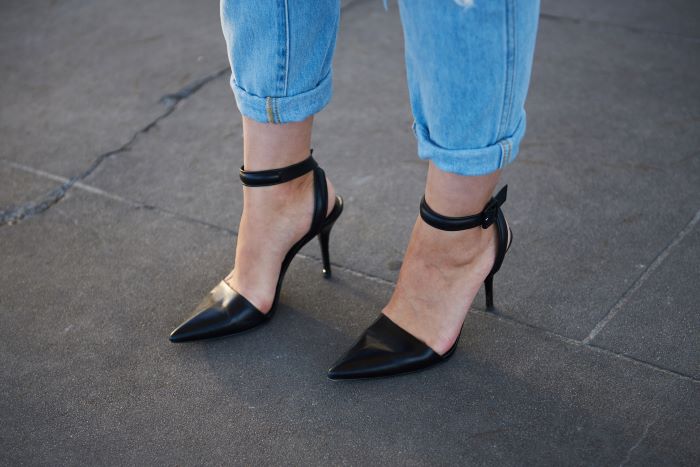
THEY ARE SIMPLY UNCOMFORTABLE!
They can cause the appearance of bunions and even bruises under the toenails, caused by constant pressure. In addition, if they also have a high heel, the body weight will be supported only on the fingers, which are tight in the sharp tip of the shoe. This increases the risk of instability and painful corns may occur in the fingers.
SOLUTION: Shoes with a wider anterior part, which will not tighten the sides of your fingers, preferably made of a softer material instead of a rigid material.
This also applies to men's shoes. Just like women, men should avoid shoes that are uncomfortable and sharp.

I always follow professional workflow and provide you the best service with reliable costs.



The waist-balance ratio refers to the ratio between the size of the waist circumference and that of the hips ...
Winter sports, skiing or snowboard, can become dangerous if the body is not properly prepared or trained or if ...
Migraine is a moderate or severe headache, felt as a pulsating pain, most often on one side of the head (unilaterally) ...