

2023-04-10 00:00:00
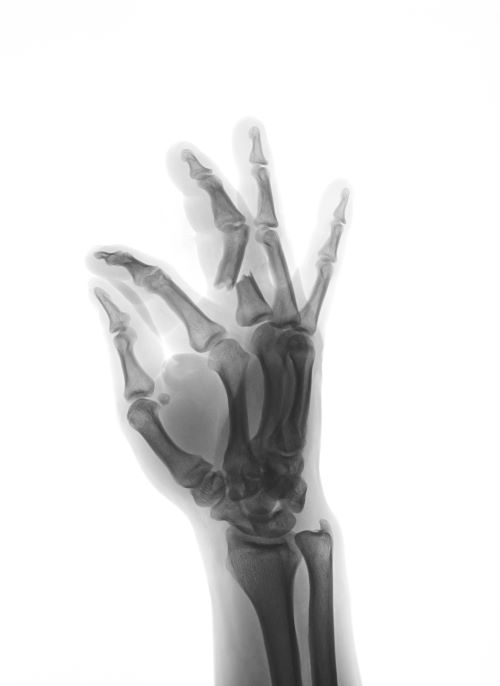
FRACTURE OF THE THUMB
The hands are the two extremities, provided with fingers, of the upper limbs, and represent the main organ ...


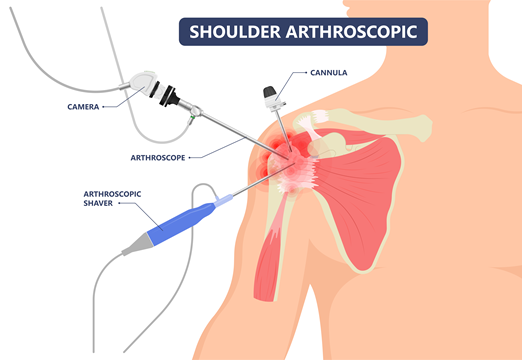
Arthroscopy is the procedure that orthopaedic surgeons use to inspect, diagnose and repair problems inside a joint.
Shoulder arthroscopy is a minimally invasive intervention that involves the realization of very small incisions, of a few millimeters, around the shoulder, penetrating it with a medical video camera (arthroscope) inside the joint or outside it. This HD video camera allows a very good view of the shoulder structures, much better than the visibility offered by open techniques, with the naked eye. In this way, it facilitates the precise diagnosis and the more efficient treatment of the present conditions. The vast majority of shoulder problems can be solved arthroscopically, except for complex fractures and shoulder prosthesis interventions
Using arthroscopy instead of classical surgeries, both in shoulder diseases and in the case of other joints, the recovery period and the return to normal activities are significantly shortened.
The shoulder is very flexible, ensuring the high-amplitude movements of the arms, which it orients in all directions. The shoulder thus allows most of the gestures in everyday life, such as: eating, writing, washing etc. In other words, keeping the shoulder mobility and its stability are very important.
The component bones of the shoulder joint are:
➢ The humerus (is the long bone of the arm)
➢ The Scapula or shoulder blade, is a flat, triangular bone, located in the posterior part of the shoulder. The upper part of the scapula is the acromion bone.
➢ The Clavicle (is a long bone that connects the scapula to the sternum)
The associated muscles, tendons and ligaments are also part of the shoulder joint.
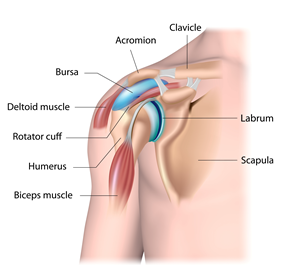
Chronic shoulder problems, such as impingement syndrome and/or rotator cuff disorders may require arthroscopy surgery (impingement syndrome is caused by inflammation of the rotator cuff tendons; the rotator cuff is a tendinous blade that covers the anterior, upper and posterior face of the shoulder joint capsule. It is composed of tendons of 4 muscles: supraspinous, infraspinous, small round muscle, subscapular muscle. By the action of these muscles, the humeral head is maintained in the shoulder joint and ensures the movement of the arm in different directions).
But in most cases, arthroscopy is performed on/around the acromio-clavicular joint. This is the joint where the acromion (upper lengthening of the shoulder blade) joins with the collarbone. Arthritis of the acromio-clavicular joint is a major requirement for arthroscopy.
Also, certain sports injuries (from sports that use a lot of shoulder movement, such as basketball, tennis) may require arthroscopic surgery.
The shoulder disorders that can be treated by arthroscopy can also affect painters, people who work in constructions (generally people who frequently raise their arms above the head)
➢ Arthroscopy should be the last therapeutic option. First try conservative treatment measures (detailed below)
➢ After surgery, you will not sleep on the operated shoulder for about 3 months
➢ If arthroscopy is used to restore tendons of the rotator cuff muscles, it may be necessary to wear an orthosis, after surgery, for up to 6 weeks, depending on the severity of the condition
➢ Physical therapy begins 2 weeks after arthroscopy, to prevent shoulder stiffness. It starts with mobilization /passive exercises, done by a physical therapist. In the absence of physical therapy, the stiffness of the shoulder can advance to "frozen shoulder" (the capsule that surrounds the joint becomes thickened leading to the stiffening of the shoulder), a condition that requires another, lighter surgical intervention called manipulation under anesthesia.
➢ The recovery time through physical therapy after shoulder arthroscopy is approximately 12 weeks. Any complication, such as secondary stiffness or frozen shoulder, can increase the recovery period.
Arthroscopy performed to restore a rupture of the rotator cuff, may require between 6-9 months of recovery by physical therapy.
➢ Driving can be resumed after 2-6 weeks, depending on the complexity of the intervention.
The shoulder should be given time to recover from the injury/the lesion.
Avoid activities that require lifting the arms (aerial activities). If an activity/movement causes pain, it will be interrupted (except for the movements recommended by the physical therapist).
Cortisone is one of the most effective anti-inflammatories. By injecting it around the joint, one can significantly alleviate the pain. But this process can be slightly painful and is not recommended very often in a joint.
Physical therapy focuses on restoring complete movement in the shoulder through:
Stretching exercises, which are extremely useful in increasing flexibility
Exercises to tone the stabilizing muscles of the shoulder
Exercises to prevent shoulder stiffness
➢ Avoid the intense repetition of some aerial movements (movements in tennis, basketball)
➢ If there is pain in the shoulder, ice is applied to the affected area to relieve pain and inflammation
➢ If certain movements can no longer be done easily, such as movements that require bringing the arms to the back (closing a bra), the advice of a doctor or physical therapist should be asked

I always follow professional workflow and provide you the best service with reliable costs.



The hands are the two extremities, provided with fingers, of the upper limbs, and represent the main organ ...
Multiple sclerosis (MS) is a potentially debilitating condition of the brain and spinal cord (central nervous system) ...
Fractures of the fingers phalanges usually occur as a result of direct blows to the hands. Most phalangeal fractures ...