


2023-03-13 00:00:00
ABDOMINAL DIASTASIS
Diastasis or abdominal dehiscence is a condition in which the abdominal muscles are separated due to the laxity ...


Spondylitis is a type of arthritis, that is, an inflammation of a joint, which generally affects the bones, muscles and ligaments of the spine, leading in time to the union of the vertebrae thus limiting movement, but not only. It can also be localized in other joints or other parts of the body. Just like most types of arthritis, spondylitis manifests with pain and inflammation in the affected joints and tissues. The sacroiliac joint is mainly affected and male people between the ages of 15 and 35 have a higher risk of developing spondylitis.
The cause of spondylitis is unknown, but genetic transmission is frequently criminalized.
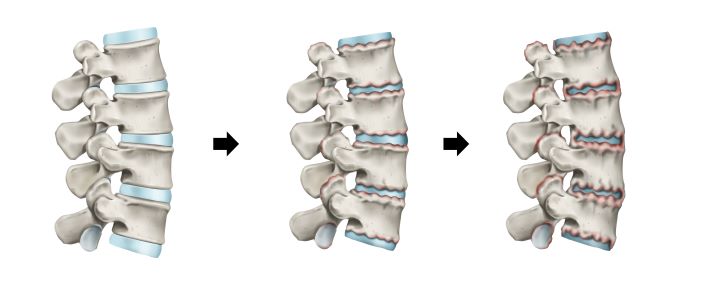
The inflammation process caused by spondylitis can be quite destructive for the spine, affecting especially the articular facets, which are small stabilizing joints that are found at every level of the spine, except for the upper level, and which provide about 20% of the torsional (twisting) stability in the neck and lumbar area and the intervertebral discs, which are fibrocartilaginous structures, placed between two vertebrae. They are essential for the movement of the spine and act as a ligament, tying a vertebra to the next, but they especially have a role in the absorption of shocks significantly diminishing the impact between the vertebrae.
Ankylosing spondylitis also causes the degeneration of the spine, leading to the fusion of the vertebrae. As a consequence, the organism reacts by flexing (bending forward) the vertebral spine.
Other internal organs that can be affected by ankylosing spondylitis are the heart, lungs and intestines, different from person to person, depending on the severity of the condition.
➢ Low back pain, which gradually worsens, accompanied by pain in the buttock muscles and which is not alleviated by rest.
➢ Stiffness of the lumbar spine, more pronounced in the morning, especially in the first 30 minutes after waking up which improves throughout the day.
➢ Pain and tenderness in the other affected joints, as well as swelling and increase in their temperature.
➢ If the ribs are affected, chest pain and shortness of breath
➢ Fatigue, weight loss, anemia may occur
Since a healing treatment does not exist, the treatment options are primarily aimed at relieving the symptoms and delaying the stiffening process
1. Physiotherapy and especially electrotherapy, is used to reduce pain and inflammation
2. Physical therapy, through specific exercise programs, based on extension, will counteract the tendency of the spine to flex (bend forward).
Physical exercises combined with massage and manual therapy, significantly help with:
✓ Pain relief
✓ Maintaining joint flexibility and mobility
✓ Delaying the installation of the stiffening process
✓ Improving breathing
3. Drug treatment
Initially mild anti-inflammatory drugs help relieve pain and inflammation and as spondylitis evolves you will need stronger anti-inflammatories, such as prednisone. There are also special drugs, anti-TNF or DMARD, for the more advanced forms of spondylitis but which are recommended only by the rheumatologist specialist.
✓ Maintaining physical activity is essential to manage stiffness; swimming and walking have an important role in delaying the stiffening process.
✓ Maintain proper posture throughout the day. At least 10 minutes a day, a perfectly stretched posture is maintained, either with the face up or face down.
✓ In the daytime, keep your back as straight as possible. A warm shower in the morning reduces stiffness while ice applied topically throughout the day, helps reduce inflammation
✓ Regular breaks from daily activities, in which extension (stretching) of the spine is practiced
✓ Quitting smoking helps when there is shortness of breath present

I always follow professional workflow and provide you the best service with reliable costs.



Diastasis or abdominal dehiscence is a condition in which the abdominal muscles are separated due to the laxity ...
Carpal tunnel syndrome is caused by compression of the median nerve. The carpal tunnel is a narrow canal, surrounded ...
The meniscus rupture is one of the most common knee injuries . Any action or activity that involves twisting or rotating ...